

Corporate Reputation Index: Apple falls, Toyota rises and the banks bite back

Flying in the face of the apparent turbulence present in the local car manufacturing industry, Toyota was today rated as the most reputable company in the nation according to the 2013 Corporate Reputation Index released by AMR and the Reputation Institute.

Knocking Apple Australia off the number one spot (Apple fell to five), Toyota has peaked in first position for the first time in the Index’s existence. It is quite the achievement for Toyota Australia who announced a $13.2 million loss after tax in June 2011.

Other automotive companies ranked well, with Mazda rising two places to rank 8th this year, Holden 10th and Ford Australia leapfrogging the competition by 12 places to rank 20th overall.

“While there may have been recalls, doubts cast over financial performance, staff layoffs and other issues facing the car industry in Australia, most people admire the fact that the companies are still here, and still operating in the local market,” says AMR’s managing director, Oliver Freedman.

Surprisingly, two of the nation’s big banks, Commonwealth and NAB, both rose significantly in reputation with Commonwealth up 21 places to rank 27th overall, and NAB jetting up the list 16 places to sit at 38th this year.

Bendigo and Adelaide Bank was ranked highest of the banks, coming 12th overall.

Westpac dropped six places to 52nd and ANZ fell nine places to rank 58th out of 60 companies measured in 2013.

“For many years, the Australian public have believed all four major banks are ‘the same’ but this year we have seen two – CBA and NAB – really separate themselves from other major players,” says Freedman.

“Interesting to note that these banks have undertaken significant communication programs and there is the perception that they have implemented real improvements in their products and service,” he adds.

Meanwhile Apple Australia’s reputation decline has more to do with how Australians view Apple’s products, its openness and transparency, and financial performance, says Freedman.

“While Apple may have initially differentiated itself in the local marketplace through true innovation, many of its more recent product launches have veered on the edge of novelty; simply updates on existing technology.”

Electronics were strong with JB HI-FI and The Good Guys in the top 10 with Air New Zealand again a surprise at 11 and the improvements in reputation for both Fairfax and News Limited a testament to their move into the digital age.

Reputation index

David Hoath latest casualty of Fairfax restructure

Fairfax’s chief operating officer of Metro Media, David Hoath, is the latest head to roll as part of the Fairfax restructure announced last week.

Hoath sent out an email this morning announcing the decision, saying he was proud to have been associated with The Age.

“I have been extremely fortunate to have had the chance of working with some outstanding and talented people who continue to innovate and deliver excellence despite massive structural changes to our business,” he wrote in the email obtained by Marketing.

Hoath was responsible for The Age, Sydney Morning Herald, Canberra Times and a host of other print and digital businesses.

He will now take time to consider his next steps, after his nearly eight-year tenure with Fairfax.


Centralised media focus brings major rejig at Fairfax

The latest reshuffle to hit Fairfax is led by the creation of a new national sales team which will represent all publications previously managed within Metro Media, Financial Review Group, Fairfax Regional Media and Agricultural Media.

Fairfax’s latest move has again been motivated by the ever-evolving new media landscape with agencies looking well beyond traditional means to turn more dollar.

The multi-pronged new team will take charge of metropolitan publications including The Sydney Morning HeraldThe Age and Canberra Times; Business publications including The Financial ReviewBRW and Smart Investor; Rural and regional publications including more than 200 mastheads.

It includes display advertising in Fairfax’s classified and transactional businesses with DomainMyCareerRSVP and Stayz, with other Fairfax brands such as Daily LifeDriveEssential BabyGood Food and The Vine all being covered.

Fairfax chief executive Greg Hywood says of the overhaul: “Fairfax has an enviable set of advertising clients. In many cases, our deep relationships with these clients span multiple Fairfax divisions, functions and brands [so] consolidating these relationships will allow us to work in true partnership and make the most of Fairfax’s large, diverse and valuable audiences.”

Meanwhile, local and direct sales for regional publications will continue to operate independently of the National Sales Team, and the Fairfax Radio Sales team will remain within the Fairfax Radio division.

Fairfax digital gun Ed Harrison has been promoted to lead the National Sales Team as Group Sales Director, reporting to newly appointed Managing Director, Australian Publishing Media, Allen Williams. But on the flipside, Metro Media chief executive Jack Matthews and Regional publishing head Allan Browne depart the company.

The management structure of the National Sales Team will be broadcast late April.


Fairfax to test pay walls overseas ahead of mid-year local launch

Fairfax will introduce pay walls to The Age and The Sydney Morning Herald in a handful of overseas test markets next week ahead of a mid-year Australian launch.

A ‘metered’ digital subscription model will be introduced on the website in three overseas test markets on 26 March ahead of the local roll out, while the apps will be updated to a freemium model, the publisher revealed today.

The website’s metered model will give readers access to a number of free articles every month before prompting them to subscribe for $15 per month. Overseas readers will be capped at 10 free articles monthly, while the number will be set higher in domestic markets, reflecting the different consumption patterns.

Fairfax’s Metro Media CEO Jack Matthews says the company is confident the metered approach is the right way to go. “It was always our plan to launch into overseas markets first to test our technology and to make sure the customer experience is a good one,” Matthews reveals.

“The meter model is proving to be the most successful with publishers overseas because it’s easy to understand and it enables less frequent readers to continue to visit the websites, just as they do now.”

Fairfax appears to be treading softly with a number of concessions included as goodwill for readers. Current two-day or more print home delivery subscribers will automatically receive full digital access in their packages. And visits to the masthead homepages, photo galleries and videos will not count towards readers’ free article allocation.

The tablet apps for The Age and The Sydney Morning Herald will remain free in every country until the pay wall is released in Australia later this year, when it will click over to a freemium model with several free sections and others available only for subscribers.

Subscribers will also receive access to a new range of features including a research tool developed in partnership with the University of Sydney that unlocks Fairfax archives, interactive eBooks curated by Fairfax journalists on specialist topics and unique offers, event invitations and access to other digital products through a domestic rewards program.

Fairfax editors and reporters took to video to explain the rationale behind the pay wall to readers:

The trial periods will be launched in North America, Europe and the Middle East, while readers from New Zealand and other Asia-Pacific countries will also be subject to the pay wall from mid year.

Initially, overseas subscribers will only be offered the option of unlimited website access from any device for $15 a month. Domestic subscribers will have access to additional subscription types, such as tablet apps and ‘all digital access’ packages, as well as bundles that include weekend and daily print home delivery. Digital access will include visits to the website from any device.

The move follows the launch of The Age and The Sydney Morning Herald in compact format early this month.

“The landscape has changed enormously over the past few years and our readers understand that we must introduce subscriptions so we can keep bringing them the best in digital news innovation,” Matthews believes.


Compact won’t stop decline: Fairfax unveils strategy behind print overhaul

BMW will be the official sponsor for the launch of The Sydney Morning Herald and The Age compact editions, which Fairfax does not expect will arrest print declines long term.

Revealing copies of the new compacts to the media for the first time this morning, Fairfax said it expects an initial uplift following the new format’s launch on 4 March, but its strategy is not based around long-term circulation gains.

“There will definitely be an increase particularly at launch,” commercial director for Fairfax Metro Media, Ed Harrison, said. “Whether or not it gives us a huge sustained lift we will have to wait and see… Our strategy is not based around significant long-term gains in circulation.”

The move from broadsheet to compact is a well-trodden path among publishers globally, having played out in the UK and US some time ago. Fairfax moved its New Zealand Herald from a broadsheet to compact in September last year, resulting in a 30% improvement in sales in the first week, before tailing off to between 2% to 5% above its broadsheet figures.

Fairfax will also introduce new sections to the papers, redesign the homepages of their websites and simplify its rate card for advertisers, although ad rates will stay the same.

Director of advertising strategy, Sarah Keith, said extensive neuro-testing and eye tracking studies had been conducted on the new formats, revealing engagement with the content had improved 22% while eye gaze on ads was up 50%.

“When people purchase from us they purchase the environment, and that remains strong,” Keith said.

The resdesign will see sport placed at the back of the paper, business placed in a self-contained section that can be lifted out of the middle and new sections ‘Pulse’, a health and wellbeing section, and ‘The Shortlist’, an expanded entertainment guide, join the existing content streams. Fairfax stressed the tone and commitment to quality journalism will not change, even though the 10% jump in font size will mean shorter stories.

Redesigned homepages for the masthead’s websites will also be rolled out a day prior to the compact’s launch, focussed on reducing clutter and making mobile sites more ‘finger friendly’.

The change marks a rejuvenation of the brands across all platforms, chief product officer Sigrid Kirk said. “Fundamentally it’s about modernising our site… we’ve tried to make it more user friendly for multiple screens and devices,” Kirk said. “You’ll find that there’s more white space making it fundamentally more tablet friendly.”

The new design will also feature elements of personalisation, zeitgeist style content, more prominence to associated properties, such as women’s network the Daily Life, and highly shared and commented on content, in what is the first major revamp for the mastheads’ online destinations in several years.

It was revealed a 20% increase in referrals through social media had been noticed since social media editors were hired for each masthead during last year’s newsroom restructure.

“We’re thrilled from the response we’ve had from our readers on this,” Kirk added. “We’re not just launching a newspaper in a new smaller shape, we’re launching a fundamentally better product.”

BMW’s sponsorship of the launch, which promotes its X1 compact SUV, will see the brand ‘metroblock’ the Herald and Age for the day across print, website, mobile and tablet.


Digital buoys masthead sales: The Aus surges 25%, but Fairfax dominates online readership

Digital newspaper subscriptions grew by 13% during weekdays and 19% on Saturdays to offset print declines and keep masthead sales above 18 million units per week, the latest circulation figures show.

During the October to December 2012 quarter, the combined average daily sales of digital subscriptions to The Australian, the Sydney Morning Herald and The Age grew by 13.4% across Monday to Friday compared with the previous quarter, while Saturday’s digital editions grew 19.0%, according to the Audit Bureau of Circulations (ABC).

Growth was strongest for The Australian which increased subscriptions to its pay wall by 26.6% Monday to Friday and 26.4% on the weekend, to reach 39,539 and 39,671 digital subscribers respectively.

The Age also grew strongly, up 18.0% on weekdays, to hit 37,162 app subscribers, and 25.4% on Saturdays, to reach 40,011.

The Herald however continues to boast the highest digital subscriber numbers with 58,532 app subscriptions on weekdays, up 3.4% quarter on quarter, and 62,431 on Saturday’s, up 11.3%.

Total masthead sales across these three publications rose slightly in the latest quarter, up by about 1%, pointing to beginnings of an offset to print declines from digital subscribers, according to CEO of The Newspaper Works, Tony Hale.

“There is a clear trend emerging that shows Australians are embracing digital publishing with growing enthusiasm,” Hale says. “Australians continue to buy more than 18 million newspapers every week and although the bulk of these are still print editions, we are now also seeing the strengthening influence of digital purchases on the overall sales figures.

“It is still early days for paid digital sales, and in coming months, we will see the rollout of digital subscriptions across more and more mastheads, supported with enthusiastic marketing by the publishers.”

In terms of total readership of mastheads, paid or not, Roy Morgan’s combined print and online readership figures show the Sydney Morning Herald leading the pack and Fairfax Media’s metropolitan titles with a higher ratio of digital readers than News Limited’s titles.

With larger digital readership bases, Fairfax’s the Herald and The Age were more resilient than News’ Daily Telegraph and Herald Sun to the impact of eroding print audiences on overall readership figures.

The Herald’s overall audience grew 0.4% quarter on quarter in the December period to reach 3.2 million weekly readers and rank as the most highly read masthead. The Herald Sun followed with 2.9 million readers, a drop of 1.8%, and the Telegraph placed third with 2.5 million readers, a drop of 3.0%. The Age place fourth with a gain of 0.8% to reach 2.4 million weekly readers.

For print circulation and readership, the familiar story of significant decline continued, with the vast majority of mastheads experiencing dips in circulation and readership year on year.

Circulation of national newspapers dropped by 8.2% overall year on year. The Australian lost 8.4% to 9.6% across the week and weekend in circulation. In terms of readership, it grew 0.7% on Monday to Fridays, and 2.1% for the weekend edition.

The Australian Financial Review dipped by 3.3% to 7.7% for circulation and 1.3% to 5.2% in readership. Paid subscription figures for the AFR were not made available by Fairfax.

Circulation of metropolitan newspapers dropped by 6.4% to 8.1% year on year across the week.

New South Wales

  • The SMH shed 13.3% to 14.5% across the week in circulation, and lost 10.0% to 14.6% in readership.
  • The Sun-Herald shed 22.9% of circulation and 18.4% of readers. Paid digital editions were sold to 58,014 (up from 56,115 in Jun-Sep) to give the masthead a combined paid circulation of 334,063 units per week.
  • The Daily Telegraph was down by 2.0% to 4.1% in circulation, and fell 8.9% to 13.4% in readership. Sunday’s Telegraph was down by 3.2% in circulation and fell 11.8% in readership. News is yet to put pay walls around its Telegraph site.

Victoria

  • The Age fell 13.4% to 14.5% across the week in circulation, and declined by 10.7% to 12.7% in readership.
  • The Sunday Age dropped 14.0% in circulation and 10.8% in readership, while the digital edition sold 37,144 units (up from 31,941 in Jul-Sep to take total masthead sales to 199,892 per week.
  • The Herald Sun lost 4.7% to 5.4% in circulation across the week, and 6.1% to 11.1% in readership. On Sunday, the Victorian paper dropped 5.7% of its circulation and 11.0% of its readership. A pay wall was erected around premium content in March last year, but News has not made figures available.

Queensland

  • The Courier-Mail experienced greater declines on Saturday (-8.7% circulation) than Monday to Friday (-3.7% circulation), while The Sunday Mail dropped 5.2% in circulation.

South Australia

  • The Advertiser’s circulation was down 5.5% Monday to Friday and between 5.4% and 5.7% for its Saturday and Sunday editions

Western Australia

  • The West Australian was down 4.0% on average across Monday to Saturday, while its Sunday edition, The Sunday Times, dipped 5.4%.

ACT

  • The Canberra Times lost 8.8% on average across Monday to Saturday, while its Sunday edition shed 8.3% of its circulation

Tasmania

  • The Mercury was down 5.1% on average across Monday to Saturday, while its Sunday edition, the Sunday Tasmanian, dropped 7.2% of circulation.

Northern Territory

  • Northern Territory News shed 7.5% in circulation across Monday to Saturday, while its Sunday edition, the Sunday Territorian, lost 4.9%.


IBM’s CEO on data, the death of segmentation and the 18-month deadline

Big data will spell the death of customer segmentation and force the marketer to understand each customer as an individual within 18 months or risk being left in the dust, according to IBM’s CEO Ginni Rometty.

Speaking yesterday at the ‘CMO+CIO Leadership Symposium’ in Sydney, Rometty outlined three paradigm shifts marketers are poised to go through, giving the industry 18 months to sink or swim.

The most telling for marketers was the shift from segmenting customers into groups to understanding and targeting each customer as an individual.

“Marketers will say my job has always been to understand customers segments,” Rometty explained. “The shift is to go from the segment to the individual. It spells the death of the average customer. Take the data and do things like real-time pricing, you’re going to do omnichannel… you’re going to bring out the latency in the data.”

The second shift covered was the evolution from reaching out to customers to creating a “system of engagement” that keeps track of interactions between brand and customer, and uses insights to maximise value creation at every touch point.

Thirdly, cultural alignment and authenticity was identified as another important shift, as data is used to personalise and contextualise interactions. Rometty, who served as IBM’s chief of marketing and communications before moving into her current roles as CEO, president and chairman of the company, stressed the importance of designing brand and culture so they are authentically one.

Transparency is important in achieving this, she says. “One of the ways I believe you can help drive a transparent culture is to make it a social enterprise.”

Yesterday’s Leadership Symposium brought together CMOs and CIOs to tackle business transformation issues as big data creates the two business divisions to work hand in hand. Analysts forecast the CMO will spend more than the CIO on technology by 2017 and predict the pair will end the year as either friend or ‘frenemy’.

Rometty believes big data will form the basis of competitive advantage, noting that once a business starts gearing around data, “it is inevitable the next thing you have to do is to link into all the information you’re already collecting”.

Her explanation to the audience of the impact data will have:

“Big data, social, mobile will form the basis of competitive advantage. Let me give you a couple of data points about big data and this next era of technology. When you think of it this way it is here to stay. All of these phenomenon are happening at exactly the same time and never in history has that happened before.

There are three Vs associated with big data. The first one is the volume of it that’s out there. Today there are two xenobytes of data [created every day]… By 2015, it will be 40 times that amount. Where on a ‘u’ curve that is [about to rapidly arch up].

The second V is velocity. The speed at which you’re seeing this data come past your company. Every two days the world creates as much data as it did through all of time until 2003. We’re used to data that fits nicely into rows and columns… but 80% of what is collected today is unstructured.

The last and the most important is the word veracity. If you look it up it means ambiguous and uncertain. All of this data, conversations, photos… what do they mean? What is the context? By 2015, 80% of all data will be uncertain. CIOs can’t write enough programs to get through this data. Just in time a new generation of computers are coming out. They’re not programs, they discover.

The difference between a market leader is always on the edges of what they do. The aggregation of business data will differentiate what you do… This is a new era of technology and because of it big data is going to form the basis of competitive advantage.”


Twitter News Index: Fairfax, ABC dominate, independents break opinion stranglehold

News sharing on Twitter in 2012 was dominated by broadsheet content with Fairfax and the ABC outstripping News Limited, while independents such as The Conversation succeeded in breaking the big publisher stranglehold on opinion content.

The Sydney Morning Herald sparked the greatest number of tweets in the last six months of 2012, both in the news and opinion categories analysed in the Australian Twitter News Index (ATNIX), an ongoing study conducted by Dr Axel Bruns of Queensland University of Technology (QUT).

The ABC’s news sites followed, commanding the second highest number of tweets during the six-month period, followed by Fairfax’s The Age, leading Dr Bruns to suggest Twitter users skew to urban, educated, affluent users, matching the typical audience for “quality news content”.

News’ broadsheet publication The Australian, stifled by its paywall, ranked in fifth spot with a minimal share of tweets compared to the top tier of publications.

“The strong performance of Fairfax’s two metropolitan broadsheets, and of Australia’s leading public service media organisation, suggests that Twitter user demographics remain skewed to the traditional audiences for relatively quality, broadsheet news, rather than for tabloid content as provided, for example, by News Ltd’s papers Herald Sun and Daily Telegraph,” writes Dr Bruns, associate professor in creative industries at QUT.

According to Bruns’ analysis, the Sydney Morning Herald accounted for around one in five tweets containing links to a news site, while the ABC’s news-related websites claimed 18%. The pair clearly led the pack for news content, between them accounting for well over a third of all tweeted links, with around 25,000 to 30,000 links to their sites tweeted each week.

The Age and news.com.au constitute a second tier of sites in terms of links shared, each commanding some 10% of the total volume of tweets. Between them, the top four sites own nearly 60% of all Australian news links being shared by Twitter users.

The remaining major news sources, led by The Australian and the two major tabloids – the Herald Sun and the Daily Telegraph – failed to claim more than 7% of volume. None managed to advance beyond 10,000 tweets per week on a regular basis, and the majority struggled to reach the 5000 tweet mark.

Spikes in news sharing occurred around WikiLeaks founder Julian Assange, ABC journalist Leigh Sales’s confrontational 7.30 interview with the opposition leader Tony Abbot and Prime Minister Julia Gillard’s now famous ‘misogyny’ speech in parliament, which made international headlines and earnt the ABC 6300 tweets over the course of two days.

While the concentration of media ownership in Australia was telling for news content, opinion content was a more open playing field with minor commentary sites able to break through with a major story at times.

Once again though, the Sydney Morning Herald was the dominant publication, commanding 23% of tweets with links to opinion content.

The Age placed second with a 14% share, beating out independent academic opinion site The Conversation by a slim margin of fewer than 2000 tweets over the past six months. Another independent, online-only opinion site, Crikey, rounds out the top four, with a share of 10%.

Against this, the ABC and News Ltd sites, home to notable commentators such as Andrew Bolt, Piers Akerman and Miranda Devine are comparatively absent, with blogs.news.com.au garnering only 7% of the total volume of tweets, while the ABC’s The Drum managed 5%. The Australian captured only 4%, again limited by its paywall.

“What’s more remarkable about the opinion and commentary field, however, is that – contrary to the mainstream of news reporting – it is possible for minor commentary sites to break through with a major story at times,” Dr Bruns points out. “New Matilda and Independent Australia both reached Crikey and even Conversation territory at least for a couple of weeks each during the past six months.

The Sydney Morning Herald’s domination of Twitter volume mirrors its command over news website traffic, with an average of 2.27 million unique visitors landing on the masthead’s site per week during the third quarter of 2012, according to Roy Morgan Research. Its closest competitor was the Herald Sun with an average of 1.34 million uniques per week.

The analysis is based on tracking all tweets which contain links pointing to the URLs of a large selection of leading Australian news and opinion sites (although it does not include‘button’ retweets, for technical reasons).

A total of over 3.9 million tweets which included links to Australian news sites – an average of some 140,000 tweets per week over the six months and two weeks between 8 June and 30 December 2012 were analysed. In addition, ATNIX tracked 580,000 tweets containing links to opinion articles.


News Ltd moves to autoplay to boost video inventory

News Limited will switch its video ad units to autoplay across its news websites next week, joining Fairfax Media as the only other major publisher to enact the controversial move.

Autoplay sees videos, preceded by pre-roll ads, start to play when readers open a page, raising concerns for viewers over user experience and for advertisers as to whether the ads are actually watched.

On News’ network, videos will start to play if 25% or more of the video window is visible to the reader, according to a story in The Australian announcing its publisher’s decision.

The move will be “popular with advertisers and media agencies because it increases exposure to their ad campaigns”, the story claims. It responds to a shortage in pre-roll video ad units, which is expected to get worse as more advertisers look to utilise video advertising online.

As with Fairfax’s videos, users will be able to change settings to turn off autoplay.


Scan-to-buy won’t fly: current apps criticised as cumbersome and fragmented

Apps that allow consumers to scan-to-buy from ads have been criticised as cumbersome and fragmented by industry players, as a number of parties fight to carve out a market in direct purchase from media – a possibility enabled by smartphones.

The retail to media integration technique, which lets people scan, email or even tweet codes to buy products seen in ads or editorial, is seen as a fight-back strategy for retailers and a means for media organisations to capture an additional revenue stream.

But a debate over scannable codes versus short text codes has been sparked, as publishers and start-ups flood the market with competing systems, requiring consumers to download and use different apps depending on where the code is seen, stifling adoption of the process.

CEO and founder of tweet/email-to-buy system, BuyReply, Brad Lindenberg, thinks short codes are more workable than QR or other scannable codes given they take up less space in print, can be used in broadcast media and don’t required the download of an app. Lindenberg says a test conducted in last year’s Harvey Norman Christmas catalogue found messaged (email) short code responses to calls to enter a competition were 25 times greater than that received via the same competition’s QR-based entry mechanism.

“Anything that requires the download of an app puts barriers of user adoption in place,” Lindenberg says. “Scanning is cumbersome and clunky, and limits basket size for merchants by requiring consumers to scan each product separately.”

BuyReply, which works by prompting consumers to respond to a call to action by tweeting or emailing a short code to receive a link to a transaction portal, lets consumers checkout multiple products in one hit. The system, which launched in August last year, was used in a recent Marie Claire advertising feature involving high profile brands Ralph Lauren, Thomas Sabo and Guess.

With point-and-scan apps circulating from the PayPal-West News tie up Point and Pay, Pacific Magazines, News Ltd and Fairfax, mobile marketing expert Joe Barber agrees fragmentation and app download are barriers to adoption of scan response. In order for it to take off, Barber says one media-agnostic app needs to rise to the top and retailers need to embrace and drive the behaviour.

“All of the scan-to-buy apps released in the US were forgotten in a month and a half,” Barber says. “The fundamental flaw in their [creators'] thinking is they ignore the consumer, rather than build a system with stickiness for the consumer that they want to use.”

Barber believes QR code scanning apps, not short code systems, are the optimal model for the technique, insisting that “the days where consumers don’t know how to use QR codes are dead and gone.”

A start-up attempting to unify retailers under one app, Sniip, is working with retail partners Dick Smith, Jeans West, Hair House Warehouse and Peep Toe Shoes towards an April consumer launch.

The start-up’s founder, ex-business development director for Myer, John Hawker, says the first step in getting scan-to-buy off the ground is getting retailers onboard. “A retail and media-agnostic app is needed to make scanning to buy ubiquitous for the consumer,” Hawker says.

Sniip, which was acquired by retail software company Rimtech last week, allows the scanning of QR codes as well as linear codes, enabling consumers to turn their smartphones into a checkout by scanning codes in offline media or on products. Hawker envisages it as a fight-back strategy for retailers being burnt by cheap online stores.

Lindenberg’s goal, however, is to take the concept a step further and get BuyReply on TV. He gives the example of buying a Nike shirt off tennis player Rafael Nadal’s back simply by tweeting the hashtag ‘raftop’ to @shopNIKE in response to a pop-up ad shown during a tennis telecast.

“We know consumers are willing to buy from the page,” he says, but making product instantly buyable in front of a TV audience while it’s being endorsed by a celebrity or playing a part in a show would be even more powerful.

“Historically, media has been designed to create purchase intent and inspire the consumer to go to a point of purchase and buy the product that’s being advertised,” Lindenberg points out. “But they haven’t been able to share financially in the demand they create.”

Scan to buy or short codes are the media’s chance to capture the purchase intent it creates, opening up a new revenue source outside of subscriptions and advertising.

Newspaper revenues forecast to drop 4% in 2013

Revenues for newspaper publishers are expected to drop by 4.0% in 2013, according to business information analyst IBISWorld.

The beleaguered sector, which saw large restructures and many redundancies at its two largest Australian businesses, is forecast to take in $6.4 billion this year, down from $6.7 billion last year.

Printed newspapers’ share of advertising – which accounts for 75% of newspaper revenue – is expected to fall to under 30% of total advertising revenue in 2013, down from a 41.8% share in 2000.

As advertisers and consumers opt for other types of media, publishers continue to lose advertising market, says IBISWorld general manager, Karen Dobie. “Declining circulation over the past five years, caused by time restraints, the rising popularity of new media like the internet, pay-TV, and mobile devices, and competition from consumer magazines has continued to have an adverse affect on the industry”, Dobie says.

Oil and gas production, forecast to grow by 15.9% in 2013, organic farming, tipped to increase 12.5%, online education predicted to grow by 10.5%, online shopping, forecast to grow by 9.1%, and multi-unit apartment and townhouse construction, slated for a 9% jump, are the five industries IBISWorld expects to soar in 2013.

Online retail is forecast to rake in almost $11.8 billion this year. “Australians are increasingly expecting traditional retailers to have an active investment in the online sphere, and to provide options for online browsing and shopping to complement their storefronts”, Ms Dobie said.

IBISWorld also expects online retailers to move into the bricks-and-mortar space, providing convenient pick up and return locations for consumers. “This phenomenon will lead to a greater increase in the convenience provided by online retail”, Dobie adds.

Gaming and vending machines manufacturing wired telecommunications carriers mineral exploration newspaper printing or publishing recorded media manufacturing and publishing are the five industries expected to sink.

Recorded media manufacturing and publishing, including CDs and records, has declined steadily over the past five years. Physical format music sales have dropped by an estimated compound annual rate of 15.9% since 2007, compared with a compound annual rise of 32.6% for digital music.

IBISWorld expects this trend to continue; “Consumers have turned away from purchasing physical media in favour of paid online subscription services, such as Spotify and Pandora, and limited free services such as YouTube and VEVO”, Dobie notes. “The industry also has been dramatically exposed to high levels of music and video piracy.”


Fairfax digital sales stall, but outstrip News’ first audited pay wall figures

Sales of digital newspaper subscriptions have stalled for Fairfax papers the Sydney Morning Herald (SMH) and The Age, but the troubled publisher outperformed rival News Ltd for digital sales in the first release of figures from behind The Australian’s pay walls.

Digital subscriptions plateaued for Fairfax during the Audit Bureau of Circulations (ABC) July to September quarter, particularly for the SMH which grew its weekday digital subscriptions by only around 4000 during the quarter compared to a 16,000-odd jump during the previous quarter.

Subscriptions to the digital edition of the Sydney-based paper numbered 56,599 during the week and 56,113* on Saturdays over the current period, well above The Australian which sold 31,241 passes to its pay-walled premium content during the week and 31,381 on the weekends.

The Age fared better, growing its digital subscribers by around 8000 to 31,502 during the week and by around 6000 to 31,894 on Saturdays, but also fell well below the growth it achieved in the previous quarter.

Print circulation for these three leading titles – of which only The Australian will remain in broadsheet format once Fairfax moves to tabloid – continued to suffer the greatest declines, dropping by 12.2% to 13.1% year on year during for the quarter. The print decline was again more marked for the SMH and The Age than for The Australian.

Despite their continual decline, CEO of The Newspaper Works, Tony Hale says printed newspapers have a solid future ahead, with around 18 million copies still sold every week. Overall sales of Monday to Saturday national, metro and regional print newspapers declined by 5.9% in the July to September quarter, a figure consistent with the previous period.

Pointing to the multi-screen approach being adopted by publishers, Hale calls the current figures “the tip of the iceberg as the whole industry begins to report total sales across all publishing platforms”.

Roy Morgan Research supplements the ABC’s circulation data with readership data that produces a combined digital-print unique audience measure. In the second release of these figures, the SMH again topped the charts, attracting an average of 3.2 million readers per week over the quarter, ahead of the Herald Sun on 2.9 million, the Daily Telegraph on 2.5 million and The Age on 2.4 million. The Australian attracted a total combined audience of 1.8 million.

Combined net print-digital readership
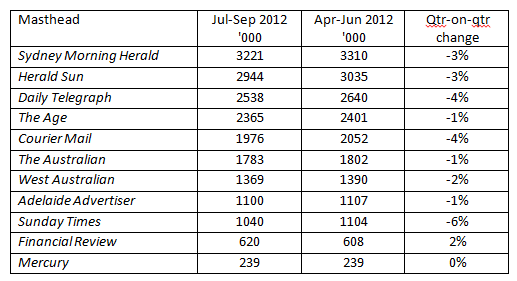
In response to Roy Morgan’s findings, CEO of News Ltd, Kim Williams, took a swipe at the researcher’s methodology and reiterated that an alternative measure will be launched by The Readership Works, which will sit alongside The Newspaper Works from the first half of next year.

“Roy Morgan’s readership data released [yesterday] is out of kilter with the ABC circulation data,” Williams says. “The discrepancies between circulation and readership illustrate the problems in the Morgan methodology.”

Quoting a 16% increase in digital subscriptions to The Australian since March, Williams says, “The growth in digital subscriptions and strong audiences for our digital sites is encouraging as we continue to transform our business in serving consumers and advertisers across a rich range of technologies – print, online, mobile, tablet and broadcast.”

Hale agrees, citing a combined average daily sales of digital editions of The Australian, the SMH, and The Age of 120,000 during the quarter, as proof that people in Australia will pay for quality journalism in both print and digital formats.

Circulation data from the ABC and readership data from Roy Morgan is shown for each of the major mastheads below.

National

Circulation of national newspapers dropped by 5.3% overall year on year.

  • The Australian lost 4.6% to 5.6% across the week in circulation. In terms of readership, it fell 1.2% on Monday to Fridays, but rose by 0.2% for the weekend edition. Across Monday to Friday, the masthead sold 31,241 digital subscriptions (16% growth since March according to unaudited figures from News) to bring total sales to 154,697. On the weekend, digital subscriptions totalled 31,381 bringing total sales to 299,106.
  • The Australian Financial Review arrested its decline relative to previous quarters, down by 3.9% to 6.5% for circulation and 8.4% to 8.8% in readership. Paid subscription figures for the AFR were not made available by Fairfax.

Metropolitan

Circulation of metropolitan newspapers dropped by 5.4% to 7.5% year on year across the week.

New South Wales

  • The SMH shed 15.1% to 15.9% across the week in circulation, and lost 9.3% to 14.0% in readership. For its digital editions, the masthead took in 56,599 (up slightly from 52,663 in April to June and 36,816 in January to March) in paid sales on Monday to Friday, resulting in a combined digital and print sales figure of 187,260 (down from 192,740 in Apr-Jun and from 198,335 in Jan-Mar). Saturday’s combined figure totalled 283,062 (down from 308,249 in Apr-Jun and from 310,410 in Jan-Mar) readers, with 56,113 (up from 56,058 in Apr-Jun and 40,158 in Jan-Mar) paying for digital editions.
  • The Sun-Herald shed 21.3% of circulation and 13.2% of readers. Paid digital editions were sold to 56,115 (up from 52,340 in Apr-Jun and from 40,268 in Jan-Mar) to give the masthead a combined paid circulation of 342,325 (down from 363,339 in Apr-Jun and from 402,350 in Jan-Mar).
  • The Daily Telegraph was down by 1.8% across Monday to Friday editions and up 0.1% on Saturdays in circulation, but fell 11.0% to 13.2% in readership. Sunday’s Telegraph was down by 1.0% in circulation and fell 10.5% in readership. News is yet to put pay walls around its Telegraph sites.

Victoria

  • The Age fell 15.1% to 16.9% across the week in circulation, and declined by 12.1% to 13.3% in readership. Digital sales of 31,502 (up from 23,811 in Apr-Jun and from 9,311 in Jan-Mar) on Monday to Friday took the overall masthead paid circulation to 173,405 (down from 180,833 in Apr-Jun to fall back in line with 170,005 in Jan-Mar), while on Saturdays 31,894 (up from 25,060 in Apr-Jun and from 9,369 in Jan-Mar) bought digital editions, taking Saturday combined masthead sales to 233,670 (down from 246,161 in Apr-Jun and from 245,597 in Jan-Mar).
  • The Sunday Age dropped 15.4% in circulation and 11.6% in readership, while the digital edition sold 31,941 units (up from 24,782 in Apr-Jun and from 9,376 in Jan-Mar) to take total masthead sales to 201,652 (up from 200,950 in Apr-Jun but still down on 210,650 in Jan-Mar).
  • The Herald Sun lost 3.5% to 4.4% in circulation across the week, and 11.0% to 14.0% in readership. On Sunday, the Victorian paper dropped 5.7% of its circulation and 14.9% of its readership. A pay wall was erected around premium content in March, but News has not made figures available.

Queensland

  • The Courier-Mail experienced greater declines on Saturday (-6.1% circulation) than Monday to Friday (-2.1% circulation), and The Sunday Mail dropped 5.4% in circulation.

South Australia

  • The Advertiser’s circulation was down 3.1% Monday to Friday and between 5.7% and 5.8% for its Saturday and Sunday editions

Western Australia

  • The West Australian was down 0.8% on average across Monday to Saturday, while its Sunday edition, The Sunday Times, dipped 4.3%.

ACT

  • The Canberra Times lost 8.0% on average across Monday to Saturday, while its Sunday edition shed 8.0% of its circulation

Tasmania

  • The Mercury was down 2.6% on average across Monday to Saturday, while its Sunday edition, the Sunday Tasmanian, dropped 6.1% of circulation.

Northern Territory

  • Northern Territory News shed 6.7% in circulation across Monday to Saturday, while its Sunday edition, the Sunday Territorian, lost 3.5%.

*The audited numbers are a daily average across July-September.