
Study: Brand Australia’s decline continues, hitting 4-year low

Brand Australia continues to decline on the world stage, slipping five places below its world-beating peak to sixth in 2012’s rankings of the world’s top country brands.

FutureBrand’s ‘2012-13 Country Brand Index’ (CBI), shows brand Australia declined in strength relative to other country brands for the third time since 2008 when it topped the rankings as the most valuable country brand in the world.

Canada, Japan, Sweden, New Zealand, and Switzerland, which topped this year’s rankings, all emerged ahead of Australia, based on perceptions of quality of life, tourism, business conditions, culture and value systems among 3600 residents, investors, tourists and government officials from 18 countries.

Australia’s decline has not been as stark as the United States’, however, which fell again in 2012, marking a fall from grace which has seen the country slip from first in 2009 to eighth place this year. The report identifies successive financial crises, a decline in the clout of Western values and questions over the nation’s public policy as factors behind its steep decline.

“Despite an upswing in brand perceptions following the 2008 appointment of President Barack Obama, attributes like ‘political freedom’, ‘stable legal environment’ and ‘freedom of speech’ have suffered declines in perception as the nation nears its 2012 presidential election,” the report reads. “Amid questions of foreign policy, the near-approaching ‘fiscal cliff’ and a staggering US$14 trillion national debt, brand USA is left to face its biggest opportunities and, possibly, setbacks during this year’s election cycle.”

In contrast, Brand UK, buoyed by eighteen months of celebrations and international coverage, rose two places this year to hover just outside the top 10 at number 11. However, the report warns the impact of the Royal Wedding, Queen Elizabeth’s Diamond Jubilee and the 2012 Olympic Games may be short lived. “While brand UK now enjoys some of the highest rankings in the CBI’s ‘awareness’, ‘familiarity’ and ‘preference’ dimensions, once the fanfare of the Olympics dies down and the ubiquitous display of the Union Jack fades, focus will turn to the United Kingdom’s uncertain future,” the report reads.

Other themes to emerge from this year’s study were the ‘hard benefits of soft power’ embodied by the social stability, freedom, tolerance, transparency and environmentalism of nations such as Switzerland, Sweden and Finland; and the ‘untapped power of the PIIGS’, which earmarks Portugal, Italy, Ireland, Greece and Spain as nations with rich cultural and natural assets.

Australia, which has ranked in the top 10 for the past eight years, came in between tenth and fourteenth place for the key major attributes of quality of life, tourism and business conditions.

In a new addition to the study, FutureBrand has published the Future Fifteen, a ranking of 15 country brands on course to transform the global landscape economically, politically and culturally in years to come. The fifteen earmarked for the future were:

Japan the only place where Twitter is more popular than Facebook

A new whitepaper from online measurement firm ComScore reports that Japan is the only country in the world where Twitter outperforms Facebook in terms of monthly unique visitors.

Unique monthly Japanese Twitter users number 21.6 million in Japan, representing a reach of 29.4%, while Facebook counts 14.4 million users, a reach of 19.6%. Japan’s next most popular social network is Mixi, a local offering that until mid-2011 rivalled Twitter, but has since dropped off and has just been taken over by Facebook.

But Business Insider predicts Twitter’s Japanese dominance may not continue for long, suggesting that if the current rates of growth continue, Facebook will overtake Twitter within a year or two. And when time spent on each site is considered, Facebook commands a much larger chunk of its users’ time.

One reason for the success of Twitter and Mixi over Facebook among internet users in Japan may be the Japanese preference for online anonymity. AdAge quotes a recent Forrester report suggesting that cultural anxieties about privacy have affected the uptake of social media.


JAPAN
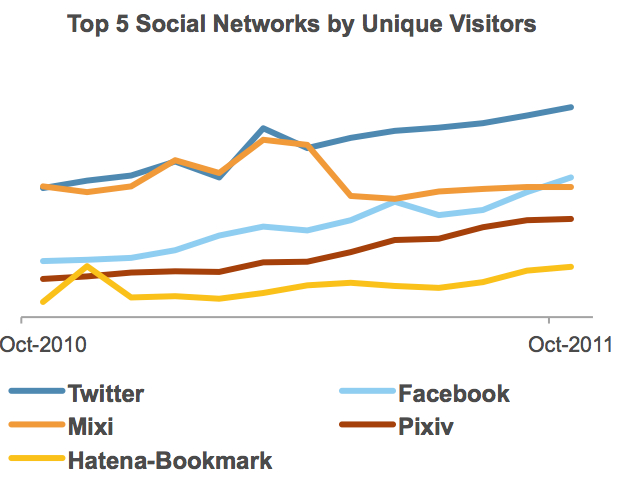
Top 5 social networks in Japan


Contrast the above graph to Australia’s, which is a more typical scenario among the 43 countries included in ComScore’s measurements.


AUSTRALIA
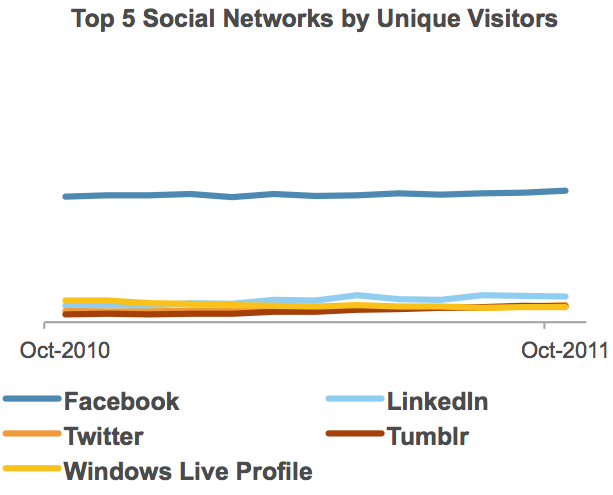
Top 5 social networks in Australia


The only other countries where Facebook doesn’t reign supreme are Russia, South Korea, Brazil and Poland, although the latter pair will not remain this way for long.

Japan is anomalous in its social media profile for another reason. While in most countries social media accounts for the majority of time spent online, now surpassing even email and porn, in Japan just 58% of the internet population uses social media. The only other country where less than 85% of internet users were using social networking was China, where Facebook and Twitter are blocked, although local substitutes enjoy popularity.
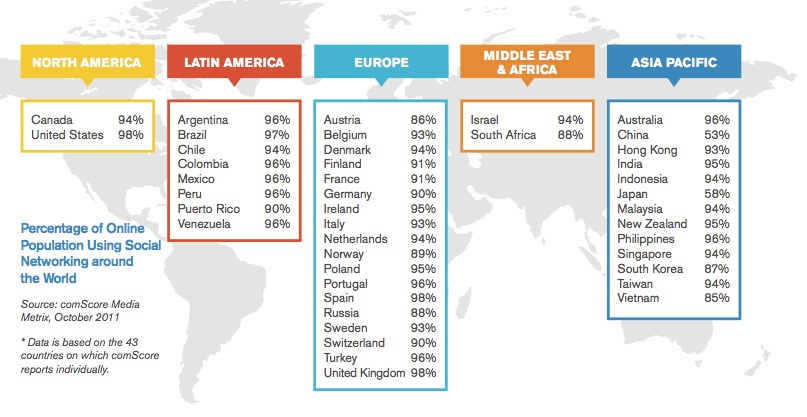
 

Worldwide social media penetration

Twitter’s top trends of 2011

Twitter is counting down to the end of 2011 with a five-part Year In Review website: a snapshot of the year that lists the trends and happenings in, as well as notable joinings to, the world of Twitter.

It began on December 1 with stories made possible through the microblogging platform such as Shohaib Athar inadvertently live-tweeting the raid on the Osama bin Laden compound in Pakistan.

December 2 brought a list of notable joinings to the Twittersphere, from tennis star Roger Federer, to the president of South Africa, to the US Secret Service.

And December 5 saw the revealing of the hottest topics to be tweeted about over the past year. As well as lists of the most discussed entertainment, sport, technology and world event topics, Twitter revealed 2011′s top eight hashtags:

  1. #egypt Social media played a notable role in the pro-democracy protests and uprisings in Egypt earlier this year, with the #egypt hashtag being attached to rallying cries as well as calls of support from all over the world.
  2. #tigerblood Despite zoology’s claims to the contrary, Charlie Sheen’s assertion that he possesses tiger blood, giving him superhuman powers, caught on.
  3. #threewordstoliveby – In which Twitter users list the three words they hold to be very important in their lives.
  4. #idontunderstandwhy – In which Twitter users list something they don’t understand. Obviously. Often about the opposite sex.
  5. #japan – The massive participation in social media in the aftermath of the earthquake, tsunami and nuclear disaster showed Twitter’s potential in emergency situations, as well as being used to deliver messages of support from around the world.
  6. #improudtosay – In a similar vein to number three, users tweet something they’re proud of.
  7. #superbowl – The Superbowl was popular on Twitter. Enough said.
  8. #jan25 – January 25 was the day Wael Ghonim became a symbol for the Egyptian democracy movement (see 1) after being detained and presciently predicting the role of the internet in the movement and in activism in general.


Part four includes stats on peaks seen in the number of tweets per second over the year, climaxing at 8868 tweets per second during the MTV Video Music Awards on August 28.

The fifth and final part of Twitter’s Year In Review is yet to be revealed…

Lollies the answer to obesity crisis?

Australia could probably learn a lot from Japan in fighting obesity, but you might be surprised by some of the foods Japanese consumers are buying to keep thin.

In a product insight report, Datamonitor analysed Japan’s confectionery market and found some quirky and insightful confectionary products that are helping battle the bulge.

“An increasing number of working Japanese men and women are becoming highly health-conscious, eating healthy foods and engaging in regular exercise. There is widespread dread of the metabolic syndrome or ‘metabo’, which connotes lifestyle diseases,” Datamonitor’s consumer markets analyst Amit Srivastava says.

The Japanese confectionery market has been far more innovative than Australia in keeping health-conscious consumers, creating products that use ingredients such as konjac powder, which swells 200 times in the stomach and prevents overeating, GABA which promotes mental relaxation, and CPP-ACP, which suppresses loss of minerals from teeth.

In 2009, Japan ranked fourth in terms of new product launches and fifth in terms of market value in the global confectionery market, and marketing health benefits of products has become a key part of confectionery promotions.

Datamonitor says Japanese consumers suffer from higher levels of work stress compared to those in other industrialised countries, due to hierarchical company structures, long working hours and long commutes between home and the workplace. This has led to the popularity of indulgent foods among Japanese office workers seeking a break from work stress.

Asia-Pacific fuels rapid growth in internet audience

A study has found that visitors to internet sites in the Asia-Pacific region has increased 22% to nearly half a billion, with most individual countries in the region experiencing double-digit growth rates.

The comScore report on the growth of internet audiences in the Asia-Pacific region was based on data from its World Metrix service.

In September 2009 the internet population in the Asia-Pacific region reached 484 million visitors, explained the report, with age groups 15-plus accessing the internet from a home or work location.

With nearly half a billion people online, the region now accounts for 41% of the total 1.2-billion person global internet audience.

China, home to the largest internet population in the world, experienced a 31% increase to 220.8 million, making it the fastest-growing internet country in the region.

Japan saw its online population increase 18% to 68.3 million, while India climbed 17% to 35.8 million users.

“With most markets in the region experiencing double-digit growth, marketers and advertisers have the opportunity to capitalise on the potential of the online channel to reach and engage a surging number of people engaging in a variety of consumer activities online, including reading content, watching video, playing online games, engaging with brands, conducting financial transactions and making online purchases,” said Will Hodgman, comScore executive vice president for the Asia-Pacific region.

Jetstar wins Best Advertiser award in Japan

Australia’s low fares airline Jetstar has been selected as one of the 100 Best Brands in the ‘Breakthrough Advertising’ category in Japan at the 20th annual Japan’s Best Advertisers Awards Ceremony.

This is the first time any Australian company has been recognised in Japan in these awards. Previous winners have included Coca-Cola, Proctor and Gamble, Apple and Nestle.

Jetstar CEO Bruce Buchanan said that winning the award was a tremendous achievement and demonstrates the significant impact Jetstar has made on the Japanese market.

“Winning this award is a real testament to the strength of the Jetstar brand and our ongoing commitment to developing a strategic position in Japan as part of our pan-Asian expansion,” Buchanan said.

“It’s a real honour for our brand to be recognised on a global scale and for Jetstar to be now seen in the same company as some of the world’s leading brands.

“Being recognised with this award is another sign that our direct to consumer strategy in the Japan market is delivering real results, helping to increase visitation of Japanese customers to Australia,” he said.

Since the start of flights between Australia and Japan in March 2007, Jetstar has commitmentted to establishing and growing its brand presence in the Japanese market.

Jetstar launched an advertising campaign featuring one of Japan’s most popular celebrities, Becky, demonstrating Jetstar’s fresh personality while celebrating low fares to Japanese consumers.

The award is presented to the top-100 companies who achieved enhanced brand value over the previous year with effective outreach to their targeted audience through impactful, creative, and high quality television advertising.

The awards are conducted each year by Japanese research organisation CM Databank following the review of more than 17,000 television commercials from 9,472 brands.

The period of eligible advertising material for this year’s awards was April 2008 to March 2009, during which the organisation reviewed all television commercials on air in Japan from more than two thousand companies.  

Feedback was also gathered from thousands of Japanese consumers in order to present an integrated review of the advertising.

First time US brand beats Oz

FutureBrand’s Country Brand Index (CBI) has rated the US number one country brand for 2009.

Australia held the top spot for the past three years, but slipped to third place in 2009 behind Canada, host of the 2010 Winter Olympics. Continuing the neighbourly correlation, New Zealand took fourth place.

FutureBrand suggest the ‘Obama effect’ is behind the US’ rise, the first time the country has taken first place in the index’s history. The company also suggest Australia has benefited from ‘The Best Job in the World’ campaign and Baz Luhrmann’s Australia – explaining the drop in place with the move toward ‘value travel’ and staycationing.

“After three years in the number one position, a remarkable achievement by any measure, this new development was just a matter of time. The measurable decline of some key attributes, combined with the revitalisation of Brand USA, has resulted in the effect on Australia’s ranking. It highlights the importance of keeping a country brand fresh, relevant and engaging – no small challenge in a highly competitive international marketplace.” said Tim Riches, CEO FutureBrand Singapore and growth officer, Asia-Pacific.

Australia remains the country most people have on their wish list to visit, live in and/or extend a business trip in.

The days of countries marketing themselves with travel posters are over. Wise governments harness, propel and amplify their country as a brand, given it also encompasses culture, exports retail, real estate and of course tax revenue. The popular phrase says ‘tourism is too big to fail,’ but if no one is paying attention or if it is undervalued or taken for granted, the competition will benefit,” said Rene A. Mack, president, Weber Shandwick Travel & Lifestyle Practice.

CBI Top Country Brands

  1. United States
  2. Canada
  3. Australia
  4. New Zealand
  5. France
  6. Italy
  7. Japan
  8. United Kingdom
  9. Germany
  10. Spain