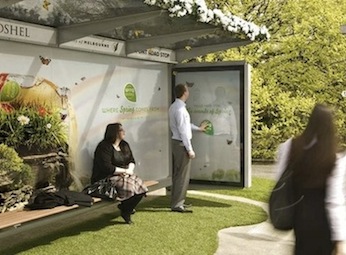

Child abuse campaign uses lenticular printing to hide its message from adults

A new campaign for a child welfare organisation The ANAR (Aid to Children and Adolescents at Risk) Foundation in Spain has created an advertisement that can only be seen by children.

Anyone under four feet, three inches can see bruising on a child’s face in the poster, along with ANAR’s hotline number and copy that reads, ‘If somebody hurts you, phone us and we’ll help you.’

Anyone taller can simply see the child without the bruise and the line. ‘Sometimes child abuse is only visible to the child suffering it.’


St. George Bank’s new brand push wants to see your inner dragon

St. George Bank is urging its customers to ‘be more awesome’ as part of a major rebrand campaign unveiled last night, on the occasion of the brand’s 75th birthday.

The new campaign, by newly-appointed creative agency Saatchi & Saatchi, is titled ‘Start Something’ and urges customers to find their ‘inner dragon’ and start doing what it is they really want to do.

George Frazis, CEO of St. George Banking Group, said the public will see a refreshed and re-energised St. George brand, linking back to the roots of St. George which this year celebrates 75 years.

“St. George was built on a foundation of helping people ‘start something’ – helping people to start saving for their first home or helping them start a business. This is the underlying concept of our brand refresh – we want to challenge and inspire people to get out there and start whatever it is they really want to do,” Frazis says.

The advertising campaign will comprise print, OOH, in branch, digital and social media and a TV commercial that will reach Australians throughout NSW, ACT, Queensland and Western Australia in both city and regional locations.

General manager strategy, marketing and customer experience for St. George Martine Jager says, ”St. George is passionate about helping customers and our local communities. We’re here to help people stop renting and start buying – if that’s what they want. Start bidding, start building, start owning, start a business – whatever it may be, we’re here to help Australians just get out there and go for it.”

“We’re really excited by the new campaign and hope that more people will back themselves and, with St. George’s support, unleash their little dragon! It takes courage and confidence to start something new, and that’s what we are hoping to inspire,” she says.


Out-of-home industry records 3.8% growth in first quarter 2013

The out-of-home advertising (OOH) industry enjoyed another solid increase in sales revenue in the first quarter of 2013. Revenue increased from $117.6 million to $122.1 million, equating to growth of 3.8% over the same period in 2012.

The industry finished up last year with overall growth of 2% and recorded $500 million in revenue for the first time.

CEO of the Outdoor Media Association (OMA), Charmaine Moldrich is confident of the industry’s ability to grow in the current financial climate. “Growth in the first quarter is a reflection of the industry’s ability to weather the vagaries of the market. OOH continues to maintain its position as a channel that is in a space of its own, growing while other mainstream media channels are being challenged.

“The OOH industry continues to remain competitive in todays changing media landscape, because we work together to thoroughly understand our audiences,” Moldrich says.

The online measurement system MOVE (Measurement of Outdoor Visibility and Exposure) has recorded a 9% increase in the total daily contacts measured by the system from 335 million to 385 million audience contacts in the last quarter.

“Our members are embracing technology, which is giving advertisers more opportunities and local and global trends are demonstrating that more people are spending a greater amount of time outdoors, making us increasingly relevant in today’s fragmented media market,” Moldrich says.

OMA members are estimating that digital revenue made up 12% of its overall revenue of $503 million in 2012. The OMA will be reporting its digital revenue as a percentage of overall revenue annually.

Figures for March 2013, year on year:

  • Roadside billboards (over and under 25 square metres) – $44.9 million
  • Roadside other (street furniture, taxis, bus/tram externals, small format) – $42.1 million
  • Transport (including airports) – $19.4 million
  • Retail – $15.6 million


Mobile and offline media: bridging the gap

In this age of digital marketing, one might believe the days of outdoor and other traditional advertising platforms are numbered. However, the emergence of new media platforms has provided several opportunities to use these traditional media in interesting ways.

The inclusion of digital services within traditional marketing creates a call to action scenario, ultimately transforming a push message into an interactive pull communication.

The three most common forms of mobile calls to action are commonly referred to as text, scan and tap.

Text: Long before there were smartphones, brands have been using SMS as a tool to provide one-on-one communication. Today, SMS remains a commonly used marketing channel because of its simplicity and ubiquity.

Scan: A more recent tool for mobile engagement is the QR code. QR codes aren’t new but the fact that your smartphone’s camera can scan and read data from a QR code has made it a popular choice for out-of-home engagement. Commonly, QR codes will simply open up a URL but they can be programmed in different ways.

Tap: Near-field communication (NFC) is a technology that uses radio fields for contactless communication. Tags can be hidden in stickers or integrated into posters or billboards. Many new smartphones now support NFC, enabling devices to simply tap a tag without having to open any apps.

When integrating text, scan or tap mobile interaction into offline advertising platforms, there are five key considerations to keep in mind.

1. Placement

A good call to action should always be prominently visible. Simply putting a tiny QR code or NFC tag at the bottom of a bus shelter ad is not going to drive much engagement. Try to reserve some dedicated space for your call to action so that it is easily noticed and not lost in the display. Walmart Canada had a great campaign with Mattel where outdoor ad space in busy train stations was used to create a virtual toy store for busy parents, featuring the must-have toys for the 2012 holiday season. With a clear, eye-level call to action, passersby were made aware of how to interact. One of the key selling points, free shipping, was featured prominently.

Walmart virtual toy store

Billboards and other large outdoor ads are typically seen from a distance. When scanning or tapping is not possible, SMS is always an option. Make sure both the keyword and SMS number are clearly visible.

2. Reach and limitations

SMS is supported by all mobile handsets and therefore has the biggest reach. QR codes work on most smartphones, either natively or via a free QR reader app. NFC devices are growing in popularity with most new Android and Windows phones having NFC chips built in. SMS works well for competition entries, text-based alerts or simple vouchers. Interactive, media rich promotions are normally targeted at smartphone users where QR codes are more suitable. NFC offers the most seamless option but tags come at a small cost and are not suitable for all print media. When running a joint QR/NFC promotion in Australia today, expect to see a 75/25 split with NFC growing steadily.

3. Relevance

The type of call to action you want to generate will influence what channel you use and how to market it. If a movie distributor wants to run a campaign with the intention of getting consumers to watch a movie trailer, it would makes sense to use a QR code as viewing the trailer would require a smartphone and the code can take them directly to the website hosting the trailer. If the call to action is to get consumers to enter a competition, SMS campaigns work well with most consumers willing to pay the cost of sending a SMS for the chance to win something. A recent study in the UK showed that 90% of consumers believe that interactivity makes an ad more effective in capturing their attention with three in four likely to interact again. Even so, don’t expect consumers to interact with you if there is no clear benefit. Campaigns that entice, educate, reward or surprise tend to drive the best interaction rates.

4. Device targeting

If you use one of the mobile channels to direct users to a URL, make sure you use a good redirection platform so you can serve up content that looks and works best on the user’s phone. This way, you can show a link to your brand’s new iPhone app exclusively to users on an iOS device – no need to show an Android user what they can’t get. Similarly, you might want to limit mandatory fields to the bare minimum for users on non-touchscreen devices as typing can put people off when using a numerical keypad.

5. Reporting

SMS campaigns, when set up properly, are a great way to build up an opt-in database of mobile numbers, a clear advantage over NFC/QR-based campaigns in some cases. Whether you use SMS, QR codes or NFC, make sure you use different identifiers for all your campaigns and if possible even for every individual ad you run. That way you can measure the performance of every single ad, any time of day. Whether your goal is to drive site traffic, Facebook likes, newsletter subscribers or sales, mobile technology can make traditional media fully accountable on a micro level.


Did you know: in each issue of the print edition, Marketing includes the very best opinion articles curated from our huge industry blogging community, as well as exclusive columnists writing on the topics that matter? Becoming a subscriber is only AU$45 for a whole year, delivered straight to your door. Find out more »

OOH audiences see 9% boost in 2012

Daily contacts with out-of-home (OOH) advertising grew by 9% year on year in 2013 at a time when other traditional media are seeing a decrease in audience numbers and market share.

The industry’s measurement system MOVE is driving the growth, its administrator the Outdoor Media Association (OMA) says, with the average person encountering 25 advertising faces each day.

The increase of 30 million daily contacts pushed total contacts up to 385 million for the year, as a result of a number of updates to data within the system including market changes, population changes and changes to signage.

“We cracked the half billion revenue mark in 2012 for the first time as an industry, that is close to 2% growth in a very volatile market and having MOVE confirm that our audiences are growing is an added boost to our plans to grow market share this year,” CEO of MOVE Charmaine Moldrich says. “With these new numbers from MOVE, we’re seeing an accurate reflection of the change in the market place and consumer behaviour, and we are poised to capitalise on this.”

Network updates contributed to 3% of the increase, while population changes added 3.5% and signage changes donated the final 2.5% increase in total daily contacts. OOH inventory has been updated to account for changes to size, location, orientation, digital conversion and lighting.

In addition the increases in total daily contacts, the recent government ‘Household Travel Survey’ (HTS) shows people are travelling further when making social and recreational trips, OMA says. Coupled with the national population growth rate of 2.8% the audience is growing and more mobile than before.

“With consumers increasingly spending their time on the move, we’re responding as an industry by embracing innovation of all types,” Moldrich adds. “OOH offers an exciting mix of inventory from billboards to street furniture, transport to retail advertising faces, with the ability to introduce technology and help consumers consume media the way they choose when they’re out and about.”

MOVE will launch its 2013 data update on Wednesday 13 March.

Adding pre-roll to TV campaign extends product launch coverage

A recent study by Millward Brown, in association with Adconion Media Group and its media agency Smartclip, tracked the impact of online video on the launch of a new FMCG products in Australia.

By using a combination of online cookie tracking and a media consumption survey that asked detailed television consumption questions of respondents. Viewing habits were then matched with media spot plans to determine the opportunity to see each media.

The study revealed that when taking the total campaign investment into effect, that the adding of pre-roll online video advertising added 2% incremental reach over TV.

But the combination of both pre-roll and out-of-home advertising, however, protracted campaign coverage by an additional 7% over and above TV, signifying the importance of planning a comprehensive and unified operation.

In addition to the 2% incremental reach pre-roll added, it was also integral in supplementing TV by best reaching light and non-TV viewers, a momentous 38% of the campaign’s audience.

“As pre-roll video ads are playing an increasingly important role in cross media plans, this study provides valuable insights for advertisers to consider when planning their media campaigns.” says Sam Smith, managing director of Smartclip APAC.

Other findings showed that the bundling of pre-roll and TV also had a significant and positive impact on return on investment. The reason being that the advertiser would have had to spend an additional 12% of total campaign budget to achieve the same reach if they had been using TV alone.

Aside from driving reach and frequency, the pre-roll lifted brand metrics beyond what TV alone could deliver, adding 30% of the impact on product awareness, while proving to be twice as cost-effective as TV in generating product awareness within the campaign.


oOh! launches consolidated airport offering after acquiring Eye

oOh!media, following its recent acquisition of Eye Corp, launched its consolidated digital airport media offering last night at Sydney’s Qantas domestic airport terminal.

The new digital airport offering is part of an $11 million investment in Qantas terminals in Sydney, Melbourne, Brisbane and Perth.

oOh!’s fleet of airport signage features high-definition digital roadside billboards, and digital and back-lit advertising within terminals, including installations near Qantas Club, valet parking and baggage carousels.

CEO of oOh!, Brendon Cook, told industry representatives the offering affords greater flexibility to advertisers. “Advertisers will easily be able to schedule different messages on digital inventory by day part, day of week and specific airport precincts to around 30 million travellers.”

oOh!’s partnership with Qantas is focused very much on premium business and leisure travelers. “All travellers – be they business or leisure flyers – are time poor, but the dwell time inside the terminal provides a unique opportunity to interact with them and influence their decisions,” Cook added.

The acquisition of Eye positions oOh! as Australia’s largest provider of airport media throughout Australia.


Eye Corp to be integrated into oOh!media brand as sale finally goes through

Out-of-home media owner oOh!media last night announced the finalisation of its acquisition of Eye Corp, owned by Ten Network Holdings, for a reduced price of $113 million, saying that it hopes to become the market leader through the combined products, services and people that will now trade under the oOh!media brand.

The off-again-on-again deal is now very much on again, and includes all of Eye’s assets and businesses in Australia, New Zealand, the US, UK and Indonesia. With the deal finalised, oOH!media’s products in Australia now include more than 4000 roadside billboards, more than 10,000 retail faces and more than 1000 airport panels.

An integration plan is being finalised, including the review and transition of staff roles and locations, but the company said the new combined entity will operate out of oOH!media’s headquarters in North Sydney, along with its state offices across Australia and international offices in New Zealand and Indonesia.

In the first official announcement back in July, oOH!media CEO Brendon Cook said it planned to sell off Eye’s unprofitable US and UK assets, citing a lack of fit with the company’s growth strategy. At that time, the deal was said to be worth $145 million, but Ten has now agreed to a reduced price of $113 million, most to be paid in cash upfront. However, Ten will have to fund the UK and US operations, helping oOH!media offload them, but if a buyer isn’t found the network might be stuck with them.


Real stats from our latest mobile-enabled OOH campaigns

Mobile is a space where big numbers are regularly forecast and occasionally, big numbers are reported too. By definition, it’s a medium where handsets, models, volumes, usage and revenue numbers are all very substantial to date, but one exception has been getting real data on how people use their mobile phones to interact with things that interest them. At Eye, we’re obviously all about out-of-home, so my interest naturally lies here. A few months ago we launched Amplify by Eye, an out-of-home advertising mobile-enabled system where the advertisers can plug in their online campaign into their out-of-home one.

That was the top line objective and we did achieve it, but not without learning a few things on the way:

  1. It’s harder than it appears – logistically and technically it’s very difficult to build a technology-agnostic application and progressively roll it out across nearly 10,000 locations in four countries. The US, representing about 4000 locations, is the last to go but is well underway now,
  2. consumers are quick to make judgements about whether there is anything relevant and valuable in it for them,
  3. simple is good and complex is bad in terms of what consumers actually see and are asked to do, and
  4. consumers are curious – even when there is no call to action on the out-of-home ad, thousands of consumers have walked up to a sign and used their mobile device to see what happens.

Six months on from launch, some of our major clients have used it and now we have the chance to share some real data from it. For better or worse, here are the results from mobile-enabled out-of-home campaigns.

Total campaigns: 12

Total interactions: 7500

Type of interaction:

  • NFC 25%
  • QR 71%
  • SMS 5%

QR codes are a clear leader, but NFC usage is disproportionately high compared to market penetration of NFC-enabled devices (which is closer to 10%). Does this mean that the early adopters who own NFC-enabled phones are more likely to notice and engage with mobile-enabled advertising? Almost certainly. But picking only one technology will by definition reduce your reach.

Note that it is still very early days with the US where SMS coupons and redemption figures are historically very high. Accordingly we expect to see a higher proportion of SMS usage in the US compared to Australia, NZ and the UK.

Device Type: iPhone still leads but Android devices are nearly on level terms:

  • Blackberry 2%
  • Android 40%
  • iPad 1%
  • Windows 9%
  • iPhone 45%
  • Mac 1%
  • Other 2%

Early on, iPhones were well in front with more than 50% of all interactions, and now after only four months Android interactions are drawing closer and Windows phone interactions have also increased. So it’s fair to say that mobile interaction patterns broadly reflect device distribution.

Interestingly, at least to me, is the fact that iPads, iPods, Nintendo 3DS, Macbooks and Galaxy Tabs have all been used to interact with Amplify tags. While the numbers are low for some of these devices, it does show that it’s not just about handsets and that some consumers better understand their devices and how to use them than perhaps advertisers do.

What’s my recommendation from this data? Design campaigns that cater for all devices, remain firmly technology agnostic, give consumers choice in how they interact, make the offer clear, make the process simple and be prepared to keep experimenting and learning as you go.


OOH surges with 6.5% third quarter growth

Out-of-home (OOH) advertising surged in the third quarter of the year, posting its eleventh consecutive quarter of growth with a 6.5% year on year increase.

According to figures from the Outdoor Media Association (OMA) the industry took in sales revenue of $120.3 million, up from $113.1 million in 2011. Year to date, it has taken in $355.8 million, a 4% increase on the same time last year.

Richard Herring, Chairman of the OMA and CEO of APN Outdoor says the results add momentum to the industry’s impressive growth trajectory. “Our ability to keep growing in a volatile media landscape is testament to our strength and relevance in today’s society,” Herring says.

Herring credits the results to the industry’s understanding of its audiences and proactive adaption to changes in the market. “We continue to invest in leading edge research and technology that meets the expectations of savvy advertisers.”

Roadside billboards drew the largest investment from advertisers, earning $44.5 million between July and September, followed by other roadside spaces such as street furniture and bus backs, on $42.9 million. Transport areas and airports earnt $18.9 million, while retail took in $14.0 million.

Year to date 2012:

  • Roadside Billboards (over and under 25 square metres) – $131.1 million
  • Roadside Other (street furniture, taxis, bus/tram externals, small format) – $128.6 million
  • Transport (including airports) – $54.7 million
  • Retail – $41.3 million

OOH: 10th quarter of growth, 13% audience increase

The out of home ad industry grew by 3% year on year during the June quarter, it’s tenth consecutive quarter of growth, as the number of Australians exposed to its footprint grew 13%.

Daily contacts with OOH ads rose from 229 million a year ago to 338 million at the end of June, according to the industry’s measurement system MOVE. This has sparked continual growth for the industry, which took in $235.5 million in ad spend during the June quarter this year.

Charmaine Moldrich, CEO of the Outdoor Media Association, says OOH continues to outstrip other traditional media channels thanks to the measurability of MOVE, which has been updated to cover more sites.

“All updates and changes to data for 2012 are the result of changing market conditions and a methodology update to the transit model within MOVE. MOVE is now able to further prove the strength of OOH by reporting on OOH’s ability to connect advertisers with even more people daily,” Moldrich says.

Since the September 2011 data release, inventory within the system has been updated to include new sites, the removal of old sites and site transfers between operators, contributing to a 5.5% increase in OOH sites measured by MOVE. In addition to these signage updates, MOVE further improved its methodology in measuring people waiting for buses. The effect of this update to the transit model broadly is a 5% – 10% increase in audience contacts for buses.

As part of this data update, MOVE software now includes the 2012 target audience potentials for each demographic, adding a further 1.8% increase to the contacts. Target audience potentials on each report should now match the OZTAM 2012 demographics.

“This methodology change allows us to confidently report improved contact data for buses; audience which was always there but we weren’t able to report on until now,” Moldrich adds.


 

Ten sells outdoor arm EYE to oOh! for $145 million

Ten has sold its outdoor advertising arm, EYE, to oOh!media for $145 million, it has been officially announced today.

oOh!media’s parent company, Outdoor Media Operations, will pay Ten $120 million at completion of the deal and a further $25 million three years after completion.

Chief executive of oOh!media, Brendon Cook, says the agreement to purchase would enhance oOh!’s ability to meet its customers’ growing demand for out-of-home advertising solutions.  “Combining these two companies will provide Australian advertisers with a broader range of solutions and innovative products to expand their reach in a competitive and rapidly evolving media environment,” Cook says.

Darren Smorgon, Director of CHAMP Private Equity, the group behind Outdoor Media Operations, adds, “We believe this will bring increased competitiveness into the advertising industry as the company can be more responsive to the needs of advertisers, it will accelerate the realisation of oOh!media’s growth objectives and assist in growing the Australian out-of-home sector.”

oOh! Plans to sell off EYE’s UK and US assets, with assistance from TEN, citing a lack of fit within oOh’s growth strategy.

The acquisition, which is subject to customary completion conditions, including regulatory and third party consents and finalisation of certain ancillary documents, will be funded via additional investment by the company’s shareholders and facilities from oOh!’s banking syndicate.