
Latest Superman film hits new viral marketing heights

Entertainment marketing continues to evolve with the latest Warner Bros Superman film trailer being projected to users via an intriguing use of viral marketing.

A new billboard located in Culver City, LA is showcasing the ‘Man of Steel’ trailer release with a clever marketing twist that drives the user through a series of clues to unearth more information pertaining to the Christopher Nolan-led reworking of the popular classic.

Using the established Kryptonian numbering shown on the Deep Space Radio Wave Project  website, the Kryptonian enscription on the billboard translates to an internet IP address of 168.161.242.137 at which the website www.IWillFindHim.com is being hosted.

Incorporating its audience into the teaser storyline where General Zod is giving Superman an ultimatum to turn himself over, fans can track the progress to see what happens next via the coding mechanism.


Out-of-home industry records 3.8% growth in first quarter 2013

The out-of-home advertising (OOH) industry enjoyed another solid increase in sales revenue in the first quarter of 2013. Revenue increased from $117.6 million to $122.1 million, equating to growth of 3.8% over the same period in 2012.

The industry finished up last year with overall growth of 2% and recorded $500 million in revenue for the first time.

CEO of the Outdoor Media Association (OMA), Charmaine Moldrich is confident of the industry’s ability to grow in the current financial climate. “Growth in the first quarter is a reflection of the industry’s ability to weather the vagaries of the market. OOH continues to maintain its position as a channel that is in a space of its own, growing while other mainstream media channels are being challenged.

“The OOH industry continues to remain competitive in todays changing media landscape, because we work together to thoroughly understand our audiences,” Moldrich says.

The online measurement system MOVE (Measurement of Outdoor Visibility and Exposure) has recorded a 9% increase in the total daily contacts measured by the system from 335 million to 385 million audience contacts in the last quarter.

“Our members are embracing technology, which is giving advertisers more opportunities and local and global trends are demonstrating that more people are spending a greater amount of time outdoors, making us increasingly relevant in today’s fragmented media market,” Moldrich says.

OMA members are estimating that digital revenue made up 12% of its overall revenue of $503 million in 2012. The OMA will be reporting its digital revenue as a percentage of overall revenue annually.

Figures for March 2013, year on year:

  • Roadside billboards (over and under 25 square metres) – $44.9 million
  • Roadside other (street furniture, taxis, bus/tram externals, small format) – $42.1 million
  • Transport (including airports) – $19.4 million
  • Retail – $15.6 million


OOH surges with 6.5% third quarter growth

Out-of-home (OOH) advertising surged in the third quarter of the year, posting its eleventh consecutive quarter of growth with a 6.5% year on year increase.

According to figures from the Outdoor Media Association (OMA) the industry took in sales revenue of $120.3 million, up from $113.1 million in 2011. Year to date, it has taken in $355.8 million, a 4% increase on the same time last year.

Richard Herring, Chairman of the OMA and CEO of APN Outdoor says the results add momentum to the industry’s impressive growth trajectory. “Our ability to keep growing in a volatile media landscape is testament to our strength and relevance in today’s society,” Herring says.

Herring credits the results to the industry’s understanding of its audiences and proactive adaption to changes in the market. “We continue to invest in leading edge research and technology that meets the expectations of savvy advertisers.”

Roadside billboards drew the largest investment from advertisers, earning $44.5 million between July and September, followed by other roadside spaces such as street furniture and bus backs, on $42.9 million. Transport areas and airports earnt $18.9 million, while retail took in $14.0 million.

Year to date 2012:

  • Roadside Billboards (over and under 25 square metres) – $131.1 million
  • Roadside Other (street furniture, taxis, bus/tram externals, small format) – $128.6 million
  • Transport (including airports) – $54.7 million
  • Retail – $41.3 million

OOH buying frenzy as London sites opened to non-Olympic sponsors

Advertisers have capitalised on the relaxation of rules that restricted outdoor media sites near Olympic venues to Games sponsors, prompting a buying frenzy.

Since restrictions were relaxed in January, non-sponsors are understood to have taken the majority of sites in the vicinity of Games venues, Media Week reports.

More than half of CBS Outdoor’s sites near Olympic venues have been sold to non-sponsors in categories approved by the London Organising Committee of the Olympic Games (LOCOG), such as the arts and tourism boards. Before the rules were loosened, a large portion of CBS sites were left unsold with sponsors focussing on premium sites.

While non-sponsors now outweigh sponsors in the Olympic zones, the value of sponsors still outstrips that of non-sponsors due to their focus on premium sites.

Business development director at media buyer Kinetic, Gideon Adey, told Media Week that the non-sponsor rush shouldn’t impact on the sponsors. “As a member of the public, you will not think ‘where are the sponsors?’ The sponsors have done big stuff such as station dominations.

“The non-sponsors have done normal advertising. Although in numbers terms, more ‘vicinity’ sites might have been sold to non-sponsors, they won’t look as though they are standing out.”


Infographic: The state of OOH advertising in Australia

Marketing takes a look at the state of the out-of-home advertising industry in Australia, with this infographic detailing the medium’s growth, which areas are on the rise, and who the big players are in the space.

You can also read Marketing‘s investigation into the factors at play in OOH’s continuing growth (hint: MOVE is but one) by clicking here. Here’s an excerpt:

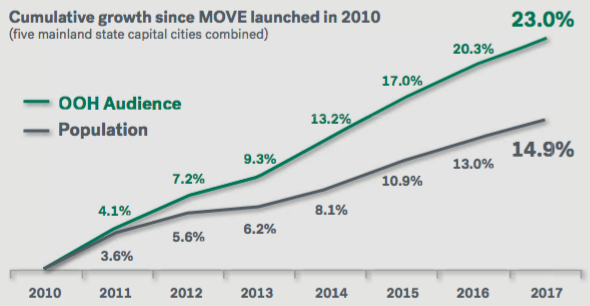
Before the introduction of MOVE in February 2010, audience measurement in OOH advertising lacked confidence, and centred on the size of audience with the opportunity to see a particular advertising face, regardless of whether or not they actually saw it.

MOVE introduced ‘Likelihood to See’ as Australia’s new audience measurement currency for OOH.

Derived by applying a visibility index – including factors such as lighting, size and the speed at which traffic passes – to the audience’s opportunity to see an advertising face, Likelihood to See measures only the audience that will probably see the advertising message.

While most media channels bounced back from the gloom of 2009 to post positive growth in 2010, OOH again posted a healthy 3.4% increase in revenue for 2011 to reach $494 million. According to the Standard Media Index, which aggregates the spends of selected major media agencies, increase in OOH spend was second only to digital last year, followed by radio and television in the black, while newspapers and magazines suffered double-digit falls.

With the OOH industry in the midst of a rather purple patch, the question is raised: how big a part has MOVE played in that? Click here for the full article.


Click anywhere on the graphic below to view it at full size.

OOH Infographic

Out-of-home: MOVE two years on

It has been two years since MOVE brought standardisation to audience measurement in Australian out-of-home advertising, and the industry hasn’t stopped growing since. But how much of that is down to MOVE? And how much to technological and consumer developments?


At the time this article went to press (for the May issue of Marketing), Australia’s out-of-home (OOH) advertising sector had just clocked up its ninth consecutive quarter of growth in terms of advertising expenditure.

It had been two years since our economy emerged from the global financial crisis, during which time only online advertising’s meteoric rise kept it in positive growth, while all other media sectors were hit hard.

It had also been two years since the Outdoor Media Association (OMA) launched the Measurement of Outdoor Visibility and Exposure (MOVE), the first national audience measurement system for the out-of-home industry in Australia. A planning tool for media buyers and advertisers, MOVE was custom-built for Australian conditions and is world-leading in terms of coverage and depth of audience measurement.

Before the introduction of MOVE in February 2010, audience measurement in OOH advertising lacked confidence, and centred on the size of audience with the opportunity to see a particular advertising face, regardless of whether or not they actually saw it.

MOVE introduced ‘Likelihood to See’ as Australia’s new audience measurement currency for OOH.

Derived by applying a visibility index – including factors such as lighting, size and the speed at which traffic passes – to the audience’s opportunity to see an advertising face, Likelihood to See measures only the audience that will probably see the advertising message.

While most media channels bounced back from the gloom of 2009 to post positive growth in 2010, OOH again posted a healthy 3.4% increase in revenue for 2011 to reach $494 million. According to the Standard Media Index, which aggregates the spends of selected major media agencies, increase in OOH spend was second only to digital last year, followed by radio and television in the black, while newspapers and magazines suffered double-digit falls.

With the OOH industry in the midst of a rather purple patch, the question is raised: how big a part has MOVE played in that?

OOH barbie tram

The tool the medium had to have

What MOVE brought to OOH advertising is a consistent audience metric – a single currency that allows more direct comparison with other broadcast media. Grant Guesdon, MOVE’s research manager, says it was a necessary tool to bring out-of-home up to speed with the rest of the traditional media, and Australia up to speed with, and beyond, the rest of the world.

“It’s the tool we had to have,” he says.

APN Outdoor’s general manager of marketing, Paul McBeth, says, “MOVE is the catalyst for giving clients the ability to benchmark against other media. It’s been pivotal in that.”

MOVE goes into detail in terms of the qualities of the site and the type of trip that the consumer is undertaking at the time that they will probably be exposed to the advertising message. For the marketer increasingly demanding justification for every promotional dollar spent (read: all of you), it means direct comparisons with the likes of television and other broadcast media. It even uses the same five primary coverage areas as television ratings system, OzTAM. Apples sitting next to apples on a proposed media schedule.

The measurement that online marketing brought about a decade ago changed advertisers’ expectations about accountability, says McBeth: “That’s what all clients really value, and that’s probably one of the things that, for a long time, was holding back the out-of-home industry.

“At the end of the day, it’s up to all media to prove their worth, and to prove that they’re worthy of a place on the media schedule.”

The country’s largest spender on OOH, Telstra, agrees: “We applaud the outdoor industry for taking the responsibility in providing clients and agencies the tools and insights to better understand the effectiveness of outdoor. However, we don’t see this as the exception, but rather the rule when dealing with media owners,” Telstra said in a statement to Marketing.

OOH shop

Confidence is contagious

A consolidated audience measurement system is what MOVE delivered in 2010.

Joe Copley, managing director of specialist out-of-home media agency Posterscope, explains, “It puts out-of-home on a more level playing field with TV, newspapers, magazines and radio because it finally gives us the opportunity to be confident when we’re talking about the number of people who have the likelihood to see the advertising in the out-of-home environment.”

McBeth adds, “I think it’s fair to say that MOVE’s introduction of the audience measurement system has given the market a lot more confidence to make a recommendation about outdoor.

“The general feeling when I talk to clients is they feel that outdoor has got a seat at the table these days, because that discussion, once upon a time, where the client would say, ‘What’s the reach and frequency? And prove to us that it’s cost-efficient,’ can be well and truly proven.”

Copley says it took about 12 months to educate the industry on MOVE to a level where agencies and media owners were able to explain all facets to clients, but for some clients it came more easily, “because we’re talking about reach and frequency numbers, which means you can compare what OOH can bring to what TV can bring”.

Using the example of FMCG advertisers, where that kind of language is common, Copley says, “For the likes of advertisers in the FMCG category, where historically TV has been a very important part of their schedule, they’re very accustomed to planning and advertising weights with regard to a reach and frequency optimum.

“For FMCGs, who are very used to talking that kind of language in order to establish a weight of advertising, then [MOVE] is a very useful tool, because that’s the kind of objective that they’re used to talking about. So, it actually becomes an easier thing for FMCG marketers to sign off on a schedule.”

OOH bus stop button

The mobile consumer

As well as the accountability provided by MOVE, the OOH industry has been bolstered by a number of other factors. Often cited is the lack of fragmentation that can occur in audiences and that is plaguing television and print media. There has also been the introduction and proliferation of a whole host of new OOH formats, including digital OOH signage. Additionally, consumer behaviour is changing, with mobile at the forefront.

Gone are the days when bus and train passengers would stare blankly at each other or out of the window. Mobile phones are a truly personal device and, with smartphone penetration in Australia reaching roughly 50%, the potential is huge for the marriage of an old medium with a new one.

For Totem Onelove Music Group, promoters of such events as Stereosonic and Creamfields, outdoor advertising plays a major role in reaching its specific audience, but primarily as a way to drive people online to the company’s content. The group’s marketing director, John Curtin, says the proliferation of outdoor sites is making OOH increasingly a catalyst for connecting the physical world to the online. “One in four people accessed our website via mobile last year for Stereosonic. That’s huge.”

Using trams as an example, he notes, “When you can advertise inside the tram using near-field communication (NFC) where people can read articles or receive samples or something like that, that will be really cool.”

Copley says it has injected interest into the category. “There’s a change in consumer behaviour through the accessibility to mobile devices, and obviously that is the reason why Wi-Fi, NFC, QR codes and all of those types of innovations are becoming a bigger area for media owners and also for agencies and advertisers.”

Ben Willee, general manager and media director at full-service agency, Spinach, says that the connection between OOH and mobile brings not only heightened engagement, but also accountability.

“It’s a really good thing, because it empowers consumers and makes the medium two-way as opposed to one-way, which it has been for a long time, and consumers expect that ability to interact,” he says.

He cites QR codes, Bluetooth and ‘tap-and-go’ NFC technology such as Tapit as trends that serve both sides of advertising. “They all go back to giving the media more accountability and more engagement. Accountability is what we and our clients want; engagement is what the consumer wants. So, it’s sort of a win-win.”

OOH digital

Digital gets some fresh air

Another factor keeping outdoor advertising up-todate is the implementation and proliferation of digital signage, which brings with it new technological capabilities, and also new challenges.

Copley says one of the benefits of digital is the specificity it allows, that lets an advertiser serve a different message at different times of day. “In airports, for example, it would be possible to advertise a newspaper message in the morning for people getting on planes to commute somewhere, and advertise an iPad app communication in the evenings for them to get the updates on the news during the day.

Curtin sees the potential, too: “It’s literally a 24-hour turnaround. So if we wanted to change a colour or change the date of an event, or the website address or anything like that, we could just do it midcampaign. That’s a really big thing for us.”

The challenge, says Copley, is that the billing systems media owners have used for years are not evolving with the technology. “All of those options should be available given the technology, but they’re not always available because the flexibility isn’t built into the systems that the suppliers are using to sell that advertising space. And that’s the challenge globally. It’s something that’s a really rich advantage for advertisers, but it’s not always set up that way in terms of the media owners to be able to buy space for a day at a time or half a day at a time.”

OOH lipton cycles

Constant refinements

Building MOVE was a huge task and the system has been embraced by the industry, says Guesdon, but MOVE and the OMA are not resting on their laurels.

In September last year, MOVE released an updated set of audience numbers, and will do the same again this year. This regular increase in audience numbers comes not only from actual increases in population and the number of trips people make, but also from the expansion of the depth of measurement the system reaches.

One example is that of bus advertising. Last year’s adjustments brought in the audience that will see a bus while it is ‘dead running’ – with no passengers, travelling between the start or end of a route and the depot, or the start of another route. Bringing in that audience increased bus audiences by 19%.

Guesdon explains: “It’s not that that audience wasn’t there, it’s just a piece of the audience that we weren’t able to understand or measure when we first launched MOVE, and having launched MOVE, we then spent 12 months looking at it and worked out how it could be captured.”

This year’s adjustments to bus advertising numbers will bring in passengers waiting at bus stops, and will probably capture about 5% more audience.

As far as major planned updates go, Guesdon says the key question is, “Where does out-of-home sit in terms of a planning concept versus other media?”

That is, the MOVE team’s current major project involves looking at the early stages of the planning process to determine where OOH sits compared to other media in the first stages of designing an integrated media shedule.

“One thing that [MOVE] is probably not doing is providing enough information upstream to help the planning process,” says Guesdon, “and that’s one of the things that the industry user group and the board identified that, moving forward, we need to address.”


A conversation with Rupert Day, global CEO of WPP’s tenthavenue

How to make mobile work with out-of-home?

Mobile and out-of-home, combining the two makes a lot of sense. There’s no shortage of technologies, no shortage of content, and no shortage of receptive consumers. I’ve been talking recently with Rupert Day, the global CEO of WPP’s tenthavenue, which focuses on reaching consumers on the move. And whilst those conversations have happened in different continents and with different focuses, there are some clear themes that emerged.

To try to refine and capture those themes, I put some questions to Rupert on how his business sees mobile.

Jeremy Corfield: The mobile phone and tablets are very personal devices for people. What is your/tenthavenue’s view on the role that these devices play in people’s daily lives?

Rupert Day: ”While both are personal, they are not the same in terms of degree and usage. Standing in an immigration queue I heard one person thanking another (they seemed not to have known each other previously) for lending them their tablet to watch a movie on the flight. This would not have been the case with the person’s mobile. A tablet is a convenient way to enjoy content on the move, and it’s also used inside the home as a parallel experience to television. That’s due to its increased functionality; being able to get additional information, and to shop as well as share with friends. Research from Viacom in the US shows that, as expected, the 18–24 demo are heavy users of tablets, especially in the dual video experience of watching TV and using tablets. However for all users, 77% of tablet use is done alone; 74% of tablet usage is done at home. How this will change with the roll-out of IPTV or ‘social TV’ remains to be seen.

“This compares with people’s mobile device which is truly personal and as additional features, such as mobile wallets, become standard this will only become more apparent.”

JC: Because mobile devices are so personal, what must marketers do differently with mobile advertising compared to other media? What are the top few tips for mobile marketing? And perhaps the top things to avoid?

RD: “The mobile device is more than another channel. People use their mobile device as an interaction device – first and foremost. That can range from checking in with their friends (voice; text and social) to retail and transactions. However all interactions have a high degree of ‘immediacy’ and normally a degree of localisation. This does not mean that the mobile device is not an effective marketing tool but any interaction needs to be personalized, not so much to the individual but to their circumstance and the environment which they are in, to ensure a high degree of relevance or even usefulness. To be successful, I recommend the following:

  • Firstly it is just so important for marketeers to really understand what they are trying to achieve from their mobile campaign. Mobile is different. People are thinking and acting differently when they are at home to when they are out of home. Any campaign has to start with this premise.
  • And therefore the location of people’s usage is important. Understand what people are looking to do from mobile depending upon where they are: ie local search vs wider content distribution.
  • This informs message relevance – the message needs to be relevant for what they are looking for at that point in time. The ability to engage is greater if we get this right but the opposite is also true if we do not.
  • The content needs to be mobile-specific – attention spans are shorter. Sending mobile users to a web site that is not mobile-optimised is a bad idea.”

JC: Out-of-home works very well as an activator for mobile. Do you have any advice on how best to combine the two media?

RD: ”People spend so much time outside the home in all aspects of their daily lives and the mobile device is a major part of peoples’ daily lives as their main ‘interaction’ device.

“At the same time smartphone penetration in Australia, as well as constantly emerging new technologies, not only allows distribution of more exciting and engaging content in out of home environments, but also has made the interaction between screens and other out of home experiences easier. The interaction between these experiences needs to be as ‘frictionless’ as possible. This is a mixture of the new technologies, individual comfort/habits and the environment itself.

“So we first need to understand where the audience is, what they are doing and what they are looking for. This will take research and data. Some of this needs investment but the mobile device can also act as a measuring tool. We can measure interactions with the mobile device – how much content is downloaded, and where, and then what happened next. This data will allow us to improve the experience by customising it.

“While it is clear that consumers have an understandable issue over sharing their personal data unwillingly or unknowingly, they are prepared to share it in exchange for something which is useful to them. If we make the content relevant and valuable then consumers will opt-in and be willing to share their information, all of which will allow us to improve the relevance of the messaging.

“So with those thoughts I offer not necessarily advice but some thoughts:

  • Brands need to understand the out-of-home market from an audience as well as a location perspective,
  • they (obviously) need to distribute engaging and relevant content, designed with mobile devices in mind – it’s vital that we make content not only relevant to the consumer but also relevant to the device on which it is being consumed,
  • the creative must ‘invite’ consumers to opt-in on account of the relevance to them, and
  • do not expect to get it 100% right in the beginning but be prepared to experiment and improve the value proposition to the consumer.”


So, that’s a sixty second download. Let me add my thoughts. Some of Rupert’s statements may seem self-evident but that doesn’t make them any less accurate, or any less important in getting the outcome you are looking for. Some of Rupert’s views, to my mind, highlight the shortfalls sometimes evident in mobile campaigns – reading between the lines (and he’s far too polite to say this himself), squashing a print campaign onto a little screen is a bad idea, for example. And yet it happens.  Asking people to think too hard, work hard to get to an offer, or click or pinch a lot of times will lose them. And yet plenty of campaigns I have seen have piqued interest, got me connected, and then lost/confused/frustrated me because they don’t ‘work’ like other stuff on my mobile does.

Not considering your customers’ location, and hence mindset, will decrease relevance. For mine, there are different types of out-of-home too. Places where there is some dwell time will work better. That may include obvious options like airports and malls, but also events, entertainment venues, sport. Each location is different, you are there for different reasons, and I know I for one act differently in each location too. There is one constant though – in every one of those environments, people are using their mobiles. A lot.

Food for thought.


Debate: NFC is just Bluetooth in a new dress


Near-field communication (NFC) is just Bluetooth in a new dress.


Jeremy Corfield

Jeremy Corfield

Global director, commercial

EYE

Negative – I am going to disagree with this one. Why? Because NFC is simpler, faster, cheaper and more ubiquitous than Bluetooth.

They’re different things and not just from a technology perspective. Bluetooth can do a good OOH marketing job, but for me the technology is about transmitting – push – rather than opt-in. NFC in a marketing sense, however, is all about opt-in.

Bluetooth requires a capital cost to deploy and manage transmitters, it incurs communications costs and needs to establish a pairing between two devices. These can all be overcome if the audience and location match up well and the offer is right but they do stress the business model and the consumer proposition.

NFC only requires inexpensive, unpowered tags. There is no need for a pairing – the interaction is instant, then over. Everything after that happens virtually. You don’t need a network; there is no communication cost to provide it. Its main limitation is handset availability and that is changing very quickly.

Bluetooth use hasn’t penetrated too far beyond marketing uses and connecting personal devices like your hands- free system or gaming controller. NFC is an entirely different proposition – it is embedded in a wide range of payment systems already; it is in your frequent flyer card, it’s emerging as a public transport ticketing tool, mobile wallets are on the way. So that means that ‘tapping’ will be a natural consumer behaviour in the very near future.

Let’s not forget that in a marketing sense NFC is just one technology for getting your content on to your customers’ phones. But offering it with other technologies, like QR codes and even SMS (and, if you’re really agnostic, Bluetooth too) to give your customers multiple windows to your offer, depending on their preference, goes a long way to making sure that whatever your offer, your customer can access it. OOH has done its bit – then it’s up to you.


Leah WhitfordLeah Whitford

Managing director

iOM

Negative – NFC will deliver currency and breathe new life into what has for decades been perceived as an ‘old fashioned’ and out-dated medium. NFC gives OOH a golden opportunity to provide brands with not only awareness, but also a commitment to purchase all in one hit. This interactive point of sale will provide real revenue and real business models to the OOH industry.

Unlike Bluetooth NFC’s only requirement is proximity, additionally its immediacy, simplicity and context differentiate it from Bluetooth. The reality is Bluetooth was never intended as a marketing medium. It was intended to connect to other devices or for peer-to-peer file sharing. As such there has been little investment in the channel or the technology.

Unlike Bluetooth, NFC has had considerable investment in its technology by companies with the money to drive it, for example banks, mobile manufacturers etc. With estimates

that NFC will be a standard feature in most smartphones in the next 12 months it would stand to reason that NFC (unlike Bluetooth) has a future.

Obviously, consumer adoption is the key to NFC but as smartphones and tap and pay become more and more accepted as a means of secure payment and interaction the market will naturally follow. It may not be 12 months away but certainly in the next five years.

NFC is exciting technology that will integrate the offline OOH world with the online world and provide a platform for brands to add immediate currency to their OOH campaigns.


Shaun Branagan  Shaun Branagan

Head of innovation and creative director, Melbourne

BWM

Negative – Ok, yes, you could say NFC on OOH (oh the acronyms!) is just Bluetooth in a new dress. But boy, or rather girl, what a dress! Smarter, easier to put on. Sexier. More fashionable. It’s in! It’s now! It’s the new black. Those QR (dress) codes look so last season in comparison. But hey, that’s the hectic pace of fashion, err, technology.

Personally I found Bluetooth a hassle. I never went for the Bluetooth headset look. It was too ‘call centre’ for me. And pairing devices was sometimes a tricky process.

NFC is a simpler. Tap your smartphone and you’ve got access to a brave new world of content.

But is making your outdoor poster interactive over-engineering things? Well, that depends on what you believe a brand’s role is today.

If your brand is concerned with solely pushing messages at people, then making a poster interactive, just ‘cause you can, won’t cut it. I don’t believe people want to get all interactive with their bus-stop. Unless they’re super bored. Or the bus is very late.

However, if you believe a brand’s role is to be useful, then NFC on your billboard could just be the bright new thing. Give them an offer, coupon, a recipe or some exclusive content and you’ve made the wait at the bus stop more interesting.

One brand that has gone beyond the poster and used NFC to great effect is Epic Mix – a platform developed by a consortium of ski resorts in the US. The RFID chip embedded ski pass not only gets you onto ski lifts but records your stats, stores photos and connects to your social network. In short, keeps you loyal.

But back to the question of NFC on OOH. What’s more interesting to me than which technology will ultimately dominate (Wi-Fi, Bluetooth, QR codes, NFC, Google goggles or something else) as the evolving role of the billboard from a branding tool to a direct response medium. Does that make interactive OOH just direct response in high heels?


Cameron BaxterCameron Baxter

Chief operations officer

Titan Media Group

Negative – NFC solutions can be incredibly effective if used in the correct environment. In environments where customers can act on the call to action immediately there is a real opportunity to monetise the interaction with a brand.

Our technology partner Aura Interactive is a pioneer in the space and CEO Adam Dunne explains that while NFC certainly is the shiny new name or buzz word that introduces proximity marketing and proximity payments to today’s marketer and consumer, we need to understand that Bluetooth is just one of the technologies that can be used to deliver NFC solutions, along with RFID, ultrasonic audio and WiFi.

Consumers are most concerned about what’s in it for me, the skill for the marketer is to also work out what’s in it for their brand and what they can provide for the consumer through interactivity and theatre.

Adam cites the need for a compelling and relevant offer, obtaining permission and respecting the consumer’s privacy in order to encourage opt-in. But if these elements are aligned, uptake is promising; well over five million Australian mobile devices have interacted with OOH advertisers via Bluetooth in bus shelters, shopping malls and cinemas in the past few years, which proves that when the value is there, the consumers will engage and interact.

From a brand advertising perspective, NFC offers the holy grail of ‘closing the loop’. Of being able to track consumer engagement and interaction with a media site all the way through to the point of sale. But with the next generation of NFC mobile devices this experience will be made easier even for the non-technical mass-market consumer to enjoy.

This seamless experience will ensure that over the next few years, tapping your phone on a poster for an offer or at the point of sale at your local store will become a normal behaviour.


Magnum features on first Australian outdoor ad to use facial recognition

We’ve seen facial recognition billboards launch in the UK; now we’re seeing them on home soil with the launch of Australia’s first interactive outdoor billboard.

The billboards, which will launch with ads for Streets Magnum, use facial recognition technology to identify a smile from a passer-by, which then launches the interactive element whereby the viewer can eat the Magnum, virtually. The billboard registers the user’s mouth movements and imitates it by biting the ice cream that is on screen. Users can also smile for their photo to be uploaded on to the Streets Magnum Facebook page.

The campaign, created by Spinifex Group in conjunction with JCDecaux, is being run in Sydney, Melbourne and Brisbane for the new Magnum Infinity.

Joe Peschardt, corporate director of Spinifex Group, says this is just the beginning of these types of installations as the boundaries of outdoor are pushed. “In partnership with JC Decaux, we were able to combine the latest in technology with the art of great storytelling to deliver a highly immersive, unforgettable experience,” Peschardt says.

Read: Marketing‘s Top10 outdoor campaigns from around the world.

Magnum’s campaign for the launch of Infinity comprised a teaser promotion with dancers in front of Sydney’s Customs House and TV, magazines, outdoor and digital ad spots.

Marketing director at Unilever, Andrea Martens, says the interactive billboard was adopted to “bring the pleasurable experience of new Magnum Infinity to life in a fun way.”

The activation is now live in multiple locations across the three cities including Martin Place in Sydney, Flinders Street Station in Melbourne and the Queen Street Mall in Brisbane, and will run two weeks.


Melbourne train station to trial ad-funded WiFi

Melbourne commuters will be able to access free wireless internet at Flinders Street Station from next month in return for their eyeballs and a little personal information.

Users who log on to the wireless connection, which will be available from the main concourse and platforms of the station, will be required to provide their age and gender and watch a short ad in order to use 15 minutes of the service provided by GoConnect, a provider of ‘video infotainment and interactive advertising’. A GoConnect spokesperson tells Marketing that users can watch additional ads in order to extend their connection.

The service will be introduced as a three month trial in March and extended to all city loop stations if successful.

GoConnect says the free WiFi network will reach over 15 million commuters monthly upon full penetration, a significant online platform for communication with both residents and visitors of Melbourne.

GoConnect will fund the service (supplied by broadband service provider Netbay) in order to deliver advertising on a mobile advertising model it has developed.

GoConnect is currently signing clients, and their offering is separate from the existing outdoor inventory in Melbourne’s rail network, operated by JCDecaux. That means brands wishing for a full takeover of a single train station, for example, will have to coordinate with an additional media organisation.

The company’s executive chairman, Richard Li, tells the The Herald Sun he expects the service to be quickly extended beyond the CBD to stations such as South Yarra: “Ultimately it will be all the inner city train stations, but you have to start with the most important one first.”

The City of Melbourne has committed to providing wireless internet on 33 new trains due to arrive by 2018, as part of the Future Melbourne Plan, but has no plans to upgrade the existing transport fleet due to cost barriers.

Free wireless internet is already available on most Sydney Ferries and has begun to roll out on Queensland’s suburban trains.

According to Netbay, the service will provide speeds up to 20 times faster than a 3G mobile network, but speeds will vary depending on the number of users connected at any time.

Digital OOH – What’s up Australia?

News from the UK’s Outdoor Media Centre (OMC) shows UK digital out of home (DOOH) revenues continuing to grow at a rapid rate. Why? It’s the happy convergence of OOH operators spending a very large amount of money on digitising a meaningful proportion of their inventory, and advertisers big and small diving into the space with gusto. That mirrors an emerging trend worldwide, with OOH (and DOOH within it) broadly tipped to be the second fastest growing medium in 2012, behind online.

In financial terms, the UK outcome translates into £39.3m in DOOH spend in Q4 2011, taking the 2011 total  to something near £124m or 14% of all OOH, which in turn is about 9.4% of all UK display advertising. DOOH numbers aren’t measured or distributed by the industry association in Australia, in part because only a very small number of OOH companies have really committed properly to the space, and in part because some of the niche DOOH players are not part of the Australian Outdoor Media Association.

So was it the chicken or the egg in the UK? Was this truly the market demanding everything that DOOH provides and operators following that lead? Or was it the other way around? My view is that it’s a bit of both.

After a fair bit of hesitation in the mid-2000s, the largest OOH operators have dived headlong into DOOH, particularly in indoor environments. Airports, malls and train stations have been the main focus areas. I don’t think it’s unfair to say some of the early efforts were a little haphazard, but good, meaningful networks are now in place in key environments: well-built, well-positioned and with good technology. Some brands were in from the outset, some took a while to join the party and some still remain on the outside, looking in.

The biggest difference between DOOH in the UK and Australia for me, though, is how brands are using it. In Australia we’ve seen any number of campaigns that run good, interesting, eye catching, effective animated content. They do a great job of using digital to bring their brand to life and long may they last. And we’ve seen a few that go a bit further: day parting, RSS feeds, interactive and so on. In the UK (and scale is undoubtedly important here) the curiosity of marketers and creatives has pushed the boundaries much more aggressively. Campaigns that are event or date specific, day parted, interactive, or augmented in some way are so frequent that they are almost commonplace. And whilst I don’t get to see every post-campaign analysis, I’m pretty sure that this momentum is a direct outcome of good results on previous campaigns encouraging further experimentation and breakthroughs.

With the momentum seen in the UK, we need to ask is there structural difference to Australia driving that, or are we just at a different point in the cycle? Digital billboards are an important part of the media mix in the UK and their numbers have exploded in recent years. With the current governing regulations, no animation is allowed on billboards on main roadways, but timeliness, flexibility and SOV are all being used in spades. From a regulatory perspective, Australia lags a little but hopefully more widespread deployment of outdoor digital billboards shouldn’t be too far away.

But digital billboards are only part of the UK story. By far the biggest investment in terms of dollars and scale has been (in chronological order) airports, malls and train/tube stations. Smaller cheap and nasty businesses have generally disappeared, some consolidation has occurred, format uniformity and consistency are being delivered and campaigns are working for brands. OOH companies are building DOOH starting with the customer proposition, not the technology. That very obvious fact took quite a while to sink in and plenty of failed businesses and disappointed clients resulted, not just in the UK but Europe, North America, and to some extent, in Australia.

Just like the UK, there are luddites here too, both OOH companies and advertisers. Obvious self interest aside, DOOH is not the be all and end all. But it’s a segment of a traditional sector that is moving fast. The core strength of OOH right now remains in the more ‘traditional’ space. But for how long? I’ve written previously about QR codes and how they are working with OOH – mobile technology in all its forms will fundamentally change OOH as much as it will  change other media. DOOH won’t answer all of your needs, but it can be an important part of a campaign. Demand it, and demand it be done right. Dare to be different – challenge OOH companies to deliver and use the medium to its greatest capacity.

There’s a raft of UK DOOH case studies here for those that are interested. Or for those that like QR codes, scan here to get there:


Warning: not a mobile friendly site [Ed's note – These guys might not be happy about that, Jeremy. Or this guy].


Outdoor activities

New York, Los Angeles, London, Hong Kong,  – what do all these great cities have in common?  Aside from great shopping and far too much traffic, most of the cosmopolitan cities of the world are adjourned by some of the pervasive form of communication – Outdoor Advertising.

From billboards and posters to bus-wraps and taxi signs, stand in the middle of a bustling city and chances are advertising messages will be all around you.

Love them or loath them, outdoor advertising is one medium that definitely catches your attention.

Interestingly, according to research conducted by the Outdoor Media Association (OMA), 80% of Australians are either positive or neutral towards outdoor advertising, and most actually found them interesting and humourous.

Charmaine Moldrich, CEO of OMA says: “ Most people find outdoor advertising entertaining, especially when good creativity is applied to them. We also found that the general public found the medium’s greatest strength to be its constant, 24/7 presence”.

While outdoor advertising has received negative press over inappropriate messages, OMA’s research also found that over the last year, 99.98% of all outdoor advertising compiled with codes that are self-regulated and self-imposed by industry practitioners and the OMA. 

“Although this is a great result, we cannot ignore the remaining 0.02%, and these are the ones that get picked up by the public and the media,” says Moldrich.

Some efforts that OMA will pursue over the next year include training and educating industry partners, providing free advertising space for The Advertising Standards Bureau to promote their services for the community and to offer stricter reviews and advise on content before production.

“45% of Australians feel positive about outdoor advertising and believe it provides a service of keeping them informed about new products and services,” reports Moldrich.

Outdoor advertising furniture, which includes transport shelters, bins, bridges and toilets are also kept clean and properly maintained by outdoor advertising providers.

“Not only does outdoor advertising maintain a lot of crucial public places and facilities, we also contribute up to $13.25million worth of charity each year, mostly in the form of free advertising space”,