
85% of mobile traffic to local business websites comes from Apple devices

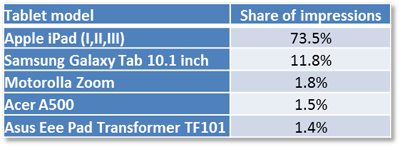
Despite Apple’s iOS and Google’s Android mobile operating systems battling neck and neck for share of the smartphone market in Australia, 85% of all mobile visits to local business websites are coming from only one of the those parties, a recent study from digital media firm Goop has found.

Apple has recently lost grip on its stronghold over the smartphone and tablet market in terms of market share, with Android devices matching or surpassing Apple in popularity among Australians, but that hasn’t stopped it dominating the important local shopping market.

Goop analysed three months of live traffic data from the web sites of more than 300 clients across Greater Geelong and regional Victoria.

“We were stunned to find that 85% of all mobile visits to our clients’ sites came from Apple devices,” says Goop’s Karl Morris. “And almost half of those visits came from iPads.”

“Safari [Apple's web browser] even out-locals Internet Explorer,” he says.

“The study found almost 35% of all visits to our clients’ sites were made on the Safari browser. Internet Explorer came second totalling 33%, with Chrome and Firefox coming in at third and fourth. Android, despite its incredible user growth, is lagging in fifth place.

“This is a big win for Apple,” Morris says.

“Local businesses looking to connect with shoppers are driving a large chunk of the digital advertising and site development market. This powerful position among local shoppers gives Apple an intriguing platform to build on,” Morris says. “Local businesses need to factor mobile shoppers into their mix.”


Tablets to reach 70% by 2017, smaller set to dominate

Tablet penetration is forecast to hit 70% by 2017 with smaller models set to dominate, new research from Telsyte shows.

The technology analysts found more than 5 million people in Australia were using tablets by the end of last year, with Apple making up around 70% of the 2.4 million units sold throughout the year.

The arrival of the iPad mini in November 2012 buoyed Apple’s sales, Telsyte says, which were being eroded by the flood of cheaper Android products hitting the market. Samsung claimed 9% of sales across the year, while the next closest competitor, Asus, accounted for 8% of sales.

The smaller form factor appears to be where the future of the market lies, with 7 to 9-inch tablets forecast to exceed sales of 10-inch devices by 2014, and a decline in cellular-enabled units expected as the home emerges as the main location of use.

“Low cost and smaller form factor media tablets, typically without cellular connectivity, are shaping the market,” Telsyte research director, Foad Fadaghi, says.

By 2013 Telsyte forecasts tablet penetration to hit 50% of homes, supporting figures in Nielsen’s ‘Australian Connected Consumers‘ report, and by 2017 prevalence of the device is expected to reach a level comparable to today’s smartphone user base.

Despite a slow start, Windows 8 tablets are expected to steadily grow in popularity, particularly with the business market, younger users and consumers looking to replace aging laptops.

The study also found tablet related ecommerce is booming, with half of all tablet users having purchased a physical product or service via their devices in 2012. Some categories are approaching similar rates of ecommerce uptake as on computers, such as event tickets and travel related purchases. Telsyte expects this trend to continue as more shopping and catalogue applications appear in 2013.

“The explosion in commercial transactions on media tablets highlights the importance of a multi-screen strategy for digital advertisers and retailers,” Fadaghi says.

Telsyte’s ‘Australian Media Tablet Study 2013-17’ surveyed a representative sample of 1000 Australians.

ABC drives mobile-first motto with new companion app

In a further sign that the ABC is an innovator in the new media broadcaster space, it is set to release its second screen ‘companion app’ on 20 March.

Mobile and tablets appear to be the broadcaster’s principal motivation going forward, feeling the television and radio format is not as strong as it once was.

Initial testing of the app will be on the comedy quiz show Tractor Monkeys in order to “trial it to see if it is the way to go,” says the ABC’s head of online and mobile, Mark Dando.

Led by the ABC’s Innovation unit, the team will also conduct a sequence of trials with third-party groups like Zeebox so they can decide on a fit, and see the real potential of this companion app. As the climate of how Australians interact with content is rapidly shifting, The ABC is at the forefront of change.

The ABC’s flagship apps were also restored to permit users to access “all related corporation content in one place”, with Dando confirming that the ABC was “reorganising [itself] to be mobile and tablet first”.

Further, akin to Fairfax’s The Age website, and the Herald Sun before it, the ABC also relaunched its own homepage after user research placed news as a priority for visitors.

With 70% of current homepage views being news related, Dando is using this data to continue to develop a news-focused site with a “simple, intuitive interface that was easy to use on tablets and on mobile phones”.


Tablets not suspected in fall of TV, but may kill the PVR

Time spent watching broadcast TV dropped noticeably in quarter four of last year, however rapidly-increasing tablet penetration in homes is not a suspect behind the downturn.

Now in 27% of Australian households, tablets were found to be supplementary to ‘traditional’ television viewing, which dropped by about 10% quarter on quarter and 3.5% year on year to an average of 91 hours and 5 minutes per month.

Nielsen, OzTAM and Regional TAM’s ‘Australian Multi-Screen Report’ and a separate tablet study found only 2% of new iPad users watch TV programs broadcast on either free-to-air or subscription television networks via the tablet devices. Other screens, including smartphones and PCs, also fail to put a major dent in the dominance of the ‘big screen’ with the television set accounting for 93% of all video content viewing.

The additional tablet study, which tracked the introduction of tablets into 30 households over 12 weeks during the second half of 2012, suggests tablets quickly entrench themselves in Australian homes when purchased, CEO of OzTAM, Doug Peiffer, says. “Their role is complementary rather than rival to TV, which remains remarkably resilient in an era of extraordinary consumer choice.”

The tablet is most commonly used to consume TV content if a program is missed on TV for reasons of convenience and portability. Around a quarter of users claim to use the tablet to watch any kind of video content in a month.

People meters attached to TV sets of participants in the special tablet study show, after an initial exploratory period, household TV screen use returns to normal, with viewing of live TV in some cases rising. Both before and after receiving tablets, 100% of study participants said the conventional TV screen was their preferred and primary device for watching TV.

However, TV playback viewing activity via PVRs was slow to recover during weekdays, suggesting the presence of tablets is influencing the days people do their catch-up viewing, with PVR use reducing and consigned to weekends.

The lion’s share of TV viewership remains live, with 93% of content consumed during broadcast slots and playback accounting for only 7% or 6 hours and 30 minutes per month.

Average daily time spent viewing television has been consistent over the past ten years, even as technology and entertainment choice causes audiences to splinter across screens. Across calendar 2012, Australians watched an average of 3 hours and 11 minutes of TV a day, compared to an average of 3 hours 18 minutes in 2003.

The combination of extended screens (PC and mobile phone, tablet time not tracked) for used for watching any video content accounts for 7% of video consumption on traditional TV sets. More than 11.1 million Australians watch video content online via a PC or laptop, for an average of 5 hours and 54 minutes per month. Such viewing is highest among people aged 18 to 24 years at 11 hours and 36 minutes.

Smartphone owners spend an average of 1 hour 20 minutes watching any video on the device each month.

Tablets are the device most likely to be used simultaneously to TV viewership, with 43% of people claiming to have done so at least once a month. On smartphones 40% were multi-tasking in concert with watching TV while 24% used laptops while watching the box.

Simultaneous tablet use is predominantly for activities unrelated to the TV program or advertising being watched, the most popular being messaging, shopping research and access of other entertainment content. Only one in three view content related to the TV program or advertising.

Technology in Australian homes is reaching new heights, the study also found. Digital TV is now practically universal, present among 98% of homes while household internet penetration is stable at 79%, with an average of 50 hours and 42 minutes spent online per month.

Internet-connected TVs can be found in 20% of homes, just behind tablets which are present in 27% of households after strong growth of 12% throughout the year.

Traditional broadcast television, however, still commands the most wide-reaching daily audience, hitting more than three quarters of the population every day.


Four big trends for 2013: actionable intelligence high on agenda

I landed in Australia from the United Kingdom eight months ago and observing where the local digital marketing industry is heading has been an interesting learning curve. I’ve completed my deep-dives and now with my head back above water, it’s clear there are some key trends that will shape the year ahead.

Turning data into actionable intelligence

Having lots of ‘big data’ from quality sources is indeed important but that’s not actually the hard part. The challenge is understanding what that data actually tells you and turning it into ‘actionable intelligence’. As technology and our expertise in matching and combining data in actionable ways continues to advance, publishers have the ability to:

  • provide insight for more effective planning
  • efficiently target the exact right audience
  • create relevance through context, and
  • measure and prove impact.

For advertisers, this intelligence enables them to deliver highly targeted and more effective campaigns that innovate and push creative boundaries for their brands.

A tablet world by 2015

We predict that tablets will overtake PCs as the primary device by 2015 tablet adoption in Australia has been extraordinary in a relatively short period of time with Telsyte reporting tablet penetration at 26% in November 2012.

And with the advent of Windows 8 devices, like the Microsoft Surface and HP Envy, the definitions of ‘what’s a tablet versus a laptop’ are blurring, while thanks to the introduction of ‘phablets’, phone/tablet hybrids are emerging.

So what does this all mean? In short, any digital experience or execution should be developed with ‘touch’ in mind. Clickable areas on devices should be no smaller than 44×44 pixels – the average finger tap – and while this may mean designers need to rethink how their advertising is being viewed and engaged with, ultimately this will enhance the consumer’s online experience and make it more likely that they will revisit the content they like time and time again.

Take a look at some of the rich, immersive experiences available on Windows 8 and you’ll see how the entire advertising experience is being re-imagined. We are currently in the midst of a global study into Cross-Screen Engagement and look forward to sharing these results in the coming months.

Mastering the art of ‘screen-weaving’

Consumers are now adept at media multi-tasking. They expect to be able to consume content anytime, anywhere. This opens up huge opportunities for publishers and brands to weave their stories across multiple screens and platforms – something we are calling “screen-weaving”.

Instead of simply duplicating content across devices, the best marketers are complementing and optimising the message depending on the screen and purpose, providing an enhanced and rewarding experience for consumers.

There are some great global examples of how this has been done well. For instance: Top Chef: Last Chance Kitchen. Chefs who have been eliminated on television meet in a version of the main show, shown on an app only, for a chance to compete to get back into the main competition.

We have some great examples of screen-weaving planned for Jump-in this year. Stay tuned.

Change is the only constant in the media industry right now

The media industry is in an era of constant change and aggressive innovation is now a way of life. Companies and their employees need to be open-minded, agile in their thinking and able to switch projects quickly.

Successful businesses and people will embrace this uncertain world and live with evolving strategies and ever-changing priorities. Managing and leading through ambiguity and change is likely to become the defining leadership competency sought after in employees in the next couple of years.

It’s going to be an interesting year ahead – one where I expect those who embrace new technology and challenge traditional marketing formulas will emerge as the winners in today’s rapidly evolving digital landscape.


Did you know: in each issue of the print edition, Marketing includes the very best opinion articles curated from our huge industry blogging community, as well as exclusive columnists writing on the topics that matter? Becoming a subscriber is only AU$45 for a whole year, delivered straight to your door. Find out more »

Desktop cannibalised: 40% of shopping searches now come from mobile

Around 40% of shopping-related Google searches now come from smartphones or tablets, a study by the search giant has found.

Looking into the habits of smartphone users, Google found that mobile and tablet search queries have grown by 138% since last year, reinforcing the shift from desktop to mobile being witnessed.

To illustrate how ingrained smartphones have become into users’ lives, Google looked at how the devices are used across the weekend in Australia, finding they’re in the average users hands as soon as they open their eyes, and one of the last things to leave them before the weekend ends.

On Saturday mornings, the devices are commonly used to check the weather (sometimes before getting out of bed), banking and booking travel. The afternoon and evening is the most common times for people to check sport scores, shopping and searching for food.

Australians check in on social networks throughout the weekend, but activity spikes at 10pm Saturday and 8pm Sunday. The impact of consumers having search in their pockets everywhere they go flows into face-to-face social settings also, with the phone often used to settle arguments on the spot, look up the definitions of new words, or cheat at the pub quiz.

Click to embiggen

Travel research is a favourite pastime for tablet owners, with 63% researching travel on their device.

Head of mobile ads at Google Australia, Jason Pellegrino, says mobile isn’t just a box to tick off. “It affects the way you plan your whole campaign,” he says. “This is what advertisers and marketers need to get right this year. They have to prioritise multi-screen and build digital-led content and campaigns that work across all screens.”


Aus marketers differ to US, UK in mobile search budget split

Australian marketers are investing more in search advertising than ever before, says digital advertising management firm Marin Software’s quarterly report on global online advertising trends, which finally includes data specific to Australia.

With international advertisers reaching record levels of investment in search on tablets and smartphones during the final quarter of 2012, the report discovered that Australian advertisers allocated their spend equally between the devices. Advertisers in the UK and US markets favoured tablets over smartphones, reflecting consumer preferences, but it was Australia who had the highest percentage of clicks from mobile devices, with a combined 26 percent from smartphones and tablets.

With impressions trumping the click volume, Marin found that paid search click volume rose 34%, with a 65% increase in impression volume. This suggests that while Australian advertisers are spending more on search advertising, “there is still vast opportunity for them to optimise their SEM campaigns,” says Nick Gill, managing director, Marin Software Australia.

“Finally Australian marketers can benchmark their campaigns against local spends and underrepresented channels,” he adds.

In another interesting discovery, Marin’s data indicates that the average click-through rate in Australia for campaigns on smartphones is on par with that of desktop computers in a unique trend to what is happening globally.

Australia has also experienced a higher average CPC than its global counterparts in click-through rates from Facebook. In this instance the social network is viewed as a cost-effective alternative that  when pitted against traditional search and display.

The full report can be downloaded here.


1 in 2 accepting of mobile ads, rapid ad upgrades end 2012

Mobile advertising has experienced rapid change in the past six months as publishers respond to the burgeoning use of devices among most smartphone adopters, half of which claim they’re comfortable with mobile ads.

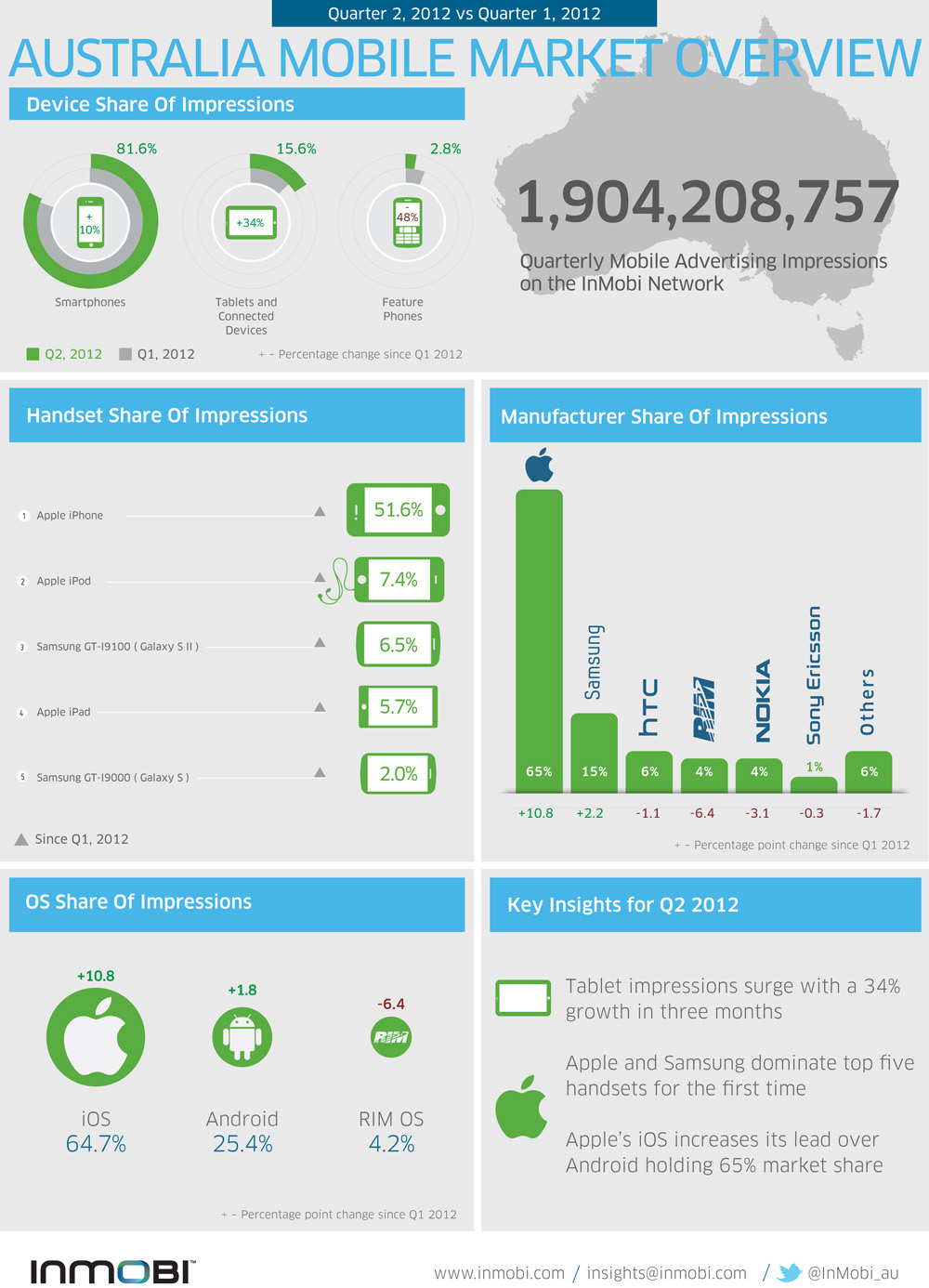
Mobile ad network InMobi’s mobile media consumption study found 54% of mobile users are as comfortable with mobile advertising as they are with TV or online advertising, while only 22% find them intrusive.

The high level of acceptance on what is a highly-personal device comes as good news for the industry and is evidence that improvements made to ad units over the past six months are keeping annoyance at commercial interruptions at bay, according to InMobi’s head of marketing, Marc Fine.

“Mobile ad units are evolving quite rapidly,” Fine says. “The competitive nature of the environment means there isn’t a publisher that isn’t putting user experience upfront.”

The majority of InMobi’s inventory is now between screen ads or ‘interstitials’, such as a unit shown between pages or between levels in a game, whereas  at the start of the year more bottom of the page and interruptive ad units existed.

“We’ve definitely seen a shift in the past six months to ad units that don’t take away from the navigating experience or the user experience,” Fine believes, pointing to healthier click-through and engagement rates as a result.

The improvements to ad units comes as smartphone use continues to reach even deeper into the downtime of even late adopters of the technology, allowing publishers to capitalise on the use of the device as a companion to a range of experiences.

Of the 7.5 hours of media time each day, mobile accounts for 100 minutes, more than the 93 minutes spent online via desktop. Since the study was last conducted in February 2012, 50% more of the Australian population is using a mobile to alleviate boredom during downtimes or as a companion.

Most commonly, the smartphone is being used while ‘waiting for something’, a behaviour used by 86% of owners, up from 43% since February. Three in four now use their devices in bed, up from 30%, 66% while watching TV, up from just 36%, 64% while commuting and 48% while shopping.

User are becoming so addicted to the always-on appeal that many are also using in the bathroom, while spending time with family and in a meeting or class.

inmobi cons 12 1

Nine in ten claim to have noticed ads while partaking in these activities, with in-app ads the most recalled, among 63% of the sample, followed by search ads and ads on retailers websites, recalled by 41% and 29% respectively.

The impact of mobile ads on purchase decision is also growing, according to InMobi. As offline media consumption, particularly print media, decline, the perceived influence of advertising in the digital environment is up.

Respondents to the research are growing increasingly likely to rate mobile as an influence on their purchasing decision, with 27% of this opinion, compared to 24% in February. The perceived influence of radio and outdoor was also up, while the impact of print and TV is believed to have dropped.

inmobi cons 12 2

For Fine, this self-reported data tells of an increase in the efficacy of mobile advertising, but also highlights the importance of an omni-channel marketing approach. “Where mobile works the best is when it runs in conjunction with tv or radio, or outdoor… It’s that amplification of channels and the integration of messaging across multiple channels as to where you see the best results.

“That’s a trend that we’re going to see next year: it’s not about running campaigns in silos, it’s about cross-media amplification and how mobile can mobile can support and complement traditional channels like outdoor, TV and radio.”


Live TV decline begins: Empowered consumers splinter away from broadcast

Viewing of live broadcast TV declined in the third quarter of calendar 2012, with more consumers moving to catch up services, and internet-connected TVs now in use in 18% of homes.

While the television set remains the hub of screen activity, according to the latest ‘Australian Multi-Screen Report’, as screen usage for non-broadcast content increases to 18.1% of the average set’s use, time spent watching live broadcast content slightly declined during the quarter.

People now spend approximately 100 hours each month watching broadcast television on the traditional set, but the share of this watched live has declined to 93%. Between July and September, consumers spent 7 hours a month watching broadcast content through some form of playback.

The prevalence of personal video recorders (PVRs), internet-connected TVs and catch up TV services is giving viewers greater choice in where, when and how much television they view, CEO of OzTAM, Doug Peiffer says.

“The insights provided by the Australian Multi-Screen Report give the industry greater clarity on evolving TV consumption habits; it shows the hub of consumers’ screen activity remains the television set, with people adding to their viewing with new devices,” Peiffer says.

Although the study, conducted by Nielsen for OzTAM, hasn’t recently measured time spent watching video on smartphones or tablets, it claims that 95% of all viewing occurs via traditional television set.

The other 5% is calculated by rolling together the current quarter’s figure for video watched via PCs or laptops with quarter four of 2011’s figure for video watched via smartphones. Time spent watching video on tablets is yet to be recorded by the study.

In the latest period, 45% of Australians watched some video (broadcast and non-broadcast content) online via a PC or laptop for on average almost 4 hours per month.

In quarter four of 2011, smartphone video watchers spent on average of 1 hour and 20 minutes per month consuming video clips.

The study estimates that tablet ownership has reached 22% of homes, up from 19% in the previous quarter.

“We continue to see that as Australians gain access to now four key screens — across TV, PC, tablet and mobile — they consume more video, continuing a long term trend of Australians being some of the most enthusiastic consumers of media in the world,” Matt Bruce, managing director of Nielsen’s Media Group, comments.

While consumers are splintering across multiple screens, the traditional TV set continues to solidify itself as the hub of media consumption. Australians are increasingly using their TV screen for non-live telecast purposes, such as gaming, viewing DVDs, online browsing and playback.

The top online activities conducted via internet TVs are watching online videos and accessing news (equally popular) followed by accessing weather information and sport news, information and results.

Apple loses ground in tablet market, Microsoft Surface expected to struggle

Apple has seen its tablet market share decline during the third quarter of the year to Google Android rivals.

The iPad maker has seen its share in the tablet market drop 15.1% to 50.4%, according to IDC. The charge of Android tablets was led by Samsung and Amazon with the former shipping 5.1 million tablets during the quarter.

Although Apple saw a drop in its market share, IDC puts this down, in part, to consumers waiting for new versions of the iPad including the highly anticipated iPad mini.

Tom Mainelli, research director of tablets at IDC says, “We believe a sizeable percentage of consumers interested in buying an Apple tablet sat out the third quarter in anticipation of an announcement about the new iPad mini. Now that the new mini, and a fourth-generation full-sized iPad, are both shipping we expect Apple to have a very good quarter.”

The tablet market grew 49.5% year on year, with the top five non-Apple vendors all seeing an increase in shipments. Samsung saw 325% growth to end the quarter with a 18.4% share of the market, while Asus, which makes the Google Nexus 7, saw a growth of 243%.

“However, we believe the mini’s relatively high $329 (AU$369) starting price leaves plenty of room for Android vendors to build upon the success they achieved in the third quarter.” Mainelli adds.

IDC expects the tablet market to heat up with the recent introduction of a number of Windows 8, such as the much hyped Surface, giving consumers a third viable tablet platform from which to choose. However, with price points critical in tablets, the analyst predicts Microsoft and its partners will have a tough time winning a share of consumer wallet with price points starting at $500.


With Macworld.

Foxtel launches live and catch-up TV app

Foxtel has launched its new iPad app making 21 of its channels available for subscribers to watch on the go.

‘Foxtel Go’ is now available for download from Apple’s App Store, signalling the pay-TV network’s first major effort to adapt to multi-screen viewing behaviour. Users will be able to watch shows live, catch up on programs they’ve missed, check the program guide and set recordings remotely from an iPad.

The channels added to the service so far include The LifeStyle Channel, A&E, Sky News, National Geographic, Discovery, Disney, Cartoon Network, Channel [V], and Cbeebies.

Foxtel CEO Richard Freudenstein says, “The TV landscape has changed, viewers are not just watching TV in the living room they’re watching TV on the way to work, at the beach or in another room of the house.

“Foxtel Go is the biggest thing we’ve launched since digital and iQ. It lets customers take their entertainment with them on the go, and as the app is included with a customer’s subscription, it’s a fantastic value proposition.”

Apple follows market pressures for first time: analyst

Yesterday’s launch of the iPad mini marks the first time in Apple’s history that the technology giant is playing catch up to its competitors, according to an analyst.

The smaller, cheaper iPad marks a significant shift in Apple’s strategy, principal analyst at technology consultancy Ovum, Adam Leach, says. “For the first time in its recent history it is responding to market pressures from its competitors, namely Google and Amazon in bringing a smaller tablet to market.”

In the past, Apple has defined new products with new form factors and waited for the market to follow, Leach notes, whereas in this instance it’s following the market trend towards smaller cheaper tablet form-factors. “This reflects a fundamental change in the way Apple operates. Apple is assuming that a lower cost iPad will allow them to sell sufficiently more units to offset the dilution in active server pages (ASP) that a cheaper device is likely to cause,” Leach adds.

James Hilton, Global CEO M&C Saatchi Mobile, which launched locally this morning, says brands are merely scratching the surface of the enormous potential smartphones and tablets offer in terms of consumer engagement.

“Tablet usage in Australia is growing at an explosive rate with penetration set to be 39% by the end of the year, more than double what it was at the end of 2011,” Hilton says.

The recent introduction of 4G in Australia and the ongoing roll out of the National Broadband Network will take the user experience on mobile and tablet devices to new heights, Hilton predicts.

Globally, shipments of tablets is expected to exceed 130 million units in calendar year 2012, rising to 349 million units in calendar year 2017, according to Ovum’s figures. The iPad is expected to comprise 54% of the market by the end of 2012, compared to 35% for Android-based tablets.