
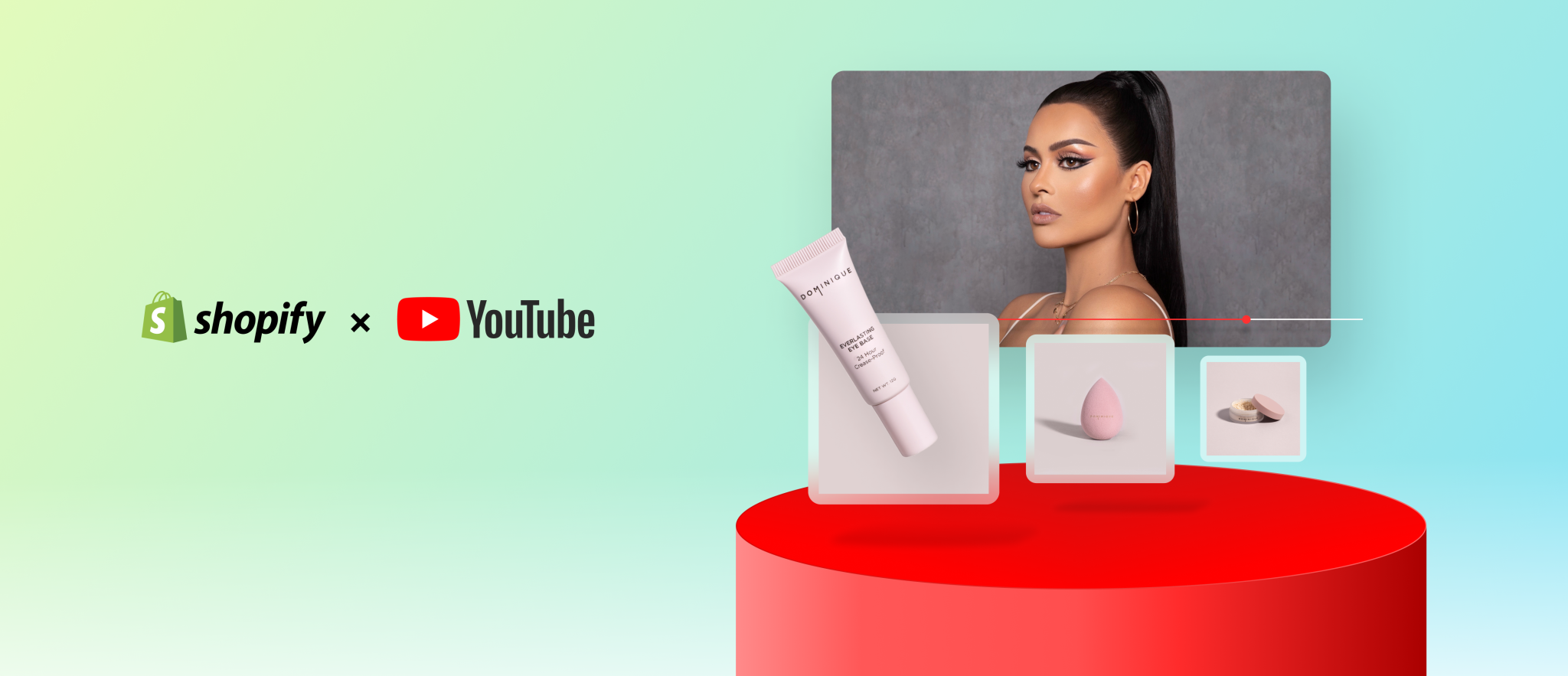
YouTube enables viewers to shop products on videos

Google is releasing a new ‘channel gadget’ that will aim shorten the path to purchase and translate video views to sales. The new technology will finally allow brands to sell products through their YouTube Channels.

The new ‘shoppable’ videos will allow brands to partner with third-party technology providers to allow viewers to click on a product and make a purchase.

Google described the changes in a blog post last week:

“To shorten the path to purchase and translate video views to sales, today we’re introducing a new channel gadget on YouTube that will enable consumer goods brands to connect consumers directly with retailers throughout the entire YouTube experience. This new channel gadget will enable shoppers to seamlessly move from browsing how-to videos and featured products to finding which retailers carry them, check availability, compare prices and make a purchase, all with fewer clicks than today.”

Hair care brand, TREsemmé, is the first to use the technology and has already built a YouTube channel featuring a number of prominent YouTube personalities and other trend setters in the hair and beauty category.

Engagement technology company, Gloto, is powering the TREsemmé site and has partnered with YouTube for similar interactive projects in the past.

Viewers watching the channel can now click on the products used in the demo videos for more information and to buy from a selection of retailers, however the new function only appears on brand channel pages — not when videos are embedded on other sites.

The experience is being powered by Gloto, an “engagement technology company” that has partnered with YouTube in the past to produce interactive mobile apps.

Google says that the new gadget will be made available as a “premium offering” for its consumer good clients, and is asking advertisers to seek out their respective Google representatives to explore the option. Google does not take a cut of sales made through the gadget, a spokesperson for the company said.

Chinese social media giant partners with Hamilton Island to promote Australia

Tencent, China’s largest online community with more than 780 million active users has partnered with Hamilton Island to broadcast the Great Barrier Reef Island to the flourishing Chinese market.

It’s the first time the social network has shifted outside of China and the third largest internet company in the world after Google and Amazon. Tencent’s QQ.com is the ninth most visited website in the world so traction for Australian is immense.

Targeting China’s affluent travellers of the future, Hamilton Island’s first Chinese ambassador Chao Xian Yang will work with Hamilton Island playmakers to build a robust Tencent Weibo community and fan base for the trendy Whitsundays’ island.

Chinese supermodel Li Ya Hong, Hamilton Island ambassador Chao Xian Yang, Tencent Weibo executive Xia Yue and a competition winner will visit Hamilton Island in May to promote Hamilton Island on Tencent Weibo.

Branded the ‘Twitter of the East’, Sophie Baker, Hamilton Island’s senior communications manager, explains the strength of the social media superpower: “China probably has more social media users than Facebook has worldwide. With China’s social media market nearly at one billion users, mostly on mobile, we are honoured to be partnering with Tencent Weibo.”

Capitalising on the high-end travel market, it’s a huge win for Hamilton Island in a monetary sense as Tencent Weibo executive Ai Fang admits. “When it comes to luxury goods, unique and high-end experiences, Tencent Weibo’s hundreds of millions of users are highly engaged consumers with high spending power,” he says.

Using Instagram, Facebook, Twitter, Tumblr, Pinterest and YouTube boomed back to the Tencent Weibo juggernaut, Hamilton Island’s social reach should increase dramatically.


YouTube domination: online video challenges TV for share of marketing spend

After recently hitting more than one billion unique visitors every month, YouTube has upped it to six billion views per month according to the Wall Street Journal. As a result, YouTube generated roughly $4 billion in revenue in 2012, up from $2.5 billion in 2011, and it has made the online medium a major drawcard for businesses looking to reach out.

In fact, countless marketing departments are leveraging YouTube by building custom channels, hiring upcoming talent, and sponsoring YouTube ‘stars’ to assist them in reaching a new audience.

“Follow the audience,” is the message from executive chairman of Google, Eric Schmidt. The chairman informed in a recent pitch to advertisers that, “your company should pay attention to the site if any of the below stats ring true for your organisation.”

  • 70% of YouTube traffic comes from outside the US and the site is localised in 53 countries and across 61 languages, and
  • in 2011, YouTube had more than one trillion views or around 140 views for every person on Earth.

And subscriptions are also key, with millions of subscriptions happening each day. Subscriptions allow you to connect with someone you’re interested in — whether it’s a friend, or the NBA — and keep up with their activity on the site.

Yet it’s the continued rise of mobile and the stats surrounding its dominance that intrigue most. With 25% of global YouTube views coming from mobile devices, that’s one billion views a day on YouTube mobile, is available on hundreds of millions of devices and traffic from mobile devices tripled in 2011, so the evidence is clear.

It has been reported that the majority of the online video traffic is for entertainment, mostly an opportunity for advertising to consumers, but there still “remains a window for businesses to create original content themselves and share it,” says Schmidt.


How Siemens uses storytelling to emotionally engage clients and staff

Keith Ritchie, storyteller at Siemens, talks to Marketing about his role as a storyteller and just how powerful telling a story can be to engage clients, potential clients, and staff.

What does story-telling mean to you?

I think story-telling is an area of expertise that some people have and that isn’t necessarily part of corporate comms, corporate affairs, media relations or anything else. It’s an area of focus for a lot of companies now, they realise that storytelling is one of the most powerful forms of communication, and that comes at a couple of different levels.

I think that good communicators, the great communicators, all really do it naturally. These days though, there is some science coming into it so that all communicators and all companies can start to consider how they use it.  I think that’s the difference.

Think of someone like Branson, he uses it all the time.  Every time I’ve seen him interviewed, he basically tells a story.  The classic one I saw was when he was explaining his lack of knowledge on finance and accounting, and he was giving an example.  He said, “I’ve been working with my chief finance officer. He’s been trying to explain to me what the difference between net and gross is,” which for most people would be a fairly simple term, and Branson says he struggles with that stuff.

He then starts telling this story where the accountant has painted a picture for him of a fishing net and all this stuff, to try and get this message across and try and explain what the difference between gross and net is, and half way through explaining this to the journalist, he goes, “Shit, I can’t remember what it was. I still don’t understand what the difference is.”

Branson uses storytelling all the time. He creates stories. Obama uses storytelling. All the great communicators do it. They either create stories, so there is a concept called story trigger where you actually will take an action that triggers storytelling, or you use it in how  you communicate.

So it’s less of a job title and more of a strategy or an idea?

I think so.  I think that it should be something that all companies really look to use. We have gone through a period where communication was all about being fast and short and to the point. That doesn’t mean that no longer has a place, it still has the same place, but storytelling is just a really powerful add on that helps you get a message across in a way that resonates and connects to people.

So there is definitely not a lack of content then?

There is absolutely no lack of content; we’ve got unbelievably rich content.  You’re talking about one of the most diverse technology companies in the world, so we’ve got energy technology that’s generating power in every different way you can think of, from wind to gas turbines and distributing power.

You’ve got a healthcare business that if you went into a hospital you would find that if you had to have some sort of treatment or care or analysis, you’re using a Siemens MRI or a Siemens CT or a Siemens ultrasound.

You’ve got an industrial sector that you would find that just about everything that you have – if you go home tonight and have dinner and have a bar of chocolate and a bottle of beer afterwards, it’s likely that Siemens technology is behind the scenes actually helping produce and manufacture those goods.

And then you’ve got an infrastructure and cities business that covers everything from smart grid to trains and trams and building technologies, security access control, energy efficiency of buildings.

The content is extremely rich. It’s a matter of picking out what the great stories are and which ones the customers will allow you to work with them on. Some customers don’t like to share what the technology has actually done for them.  But there is no shortage of great stories here.

Who would you say your main audiences are? You’re obviously after trade, but is it used internally as well?

Yes, we absolutely use storytelling internally as well. For example, we’re trying to build a really strong safety culture, especially because a lot of our people are out in quite dangerous sites and we want to make sure that they’re safe.

So to create the safety culture, we are using storytelling as one of the mechanisms, and we’ve started that process by, rather than just follow a set of rules, we want a change of mindset so that people actually want to be safe. To do that, you’ve got to make an emotional connection, and the best way to make an emotional connection is through storytelling.

We’ve got one guy who volunteered to tell his story.  He lost an eye when he was a young apprentice, and we video interviewed him, and we’ve got a series called, This Is My Safety Story. He talks about that loss of that eye and he really delivers some powerful messages because it’s authentic, it’s coming from a person, it’s not a manager telling you how you have to be safe, here is the rules you’ve got to go and follow. It actually makes you stop and think, “Gee, I want to be safe. I don’t want to lose an eye.”

It’s just a great example of how powerful story telling can be.

I’m curious about distribution strategies. Obviously having the great stories is a first step, but how do you make sure the right people get to hear them?

I guess in our business, we approach things at a few different levels, so at the top level of our business in Australia, the main message that we deliver is technology for a sustainable future. That’s our top level message, and that flows out throughout all of our businesses.  But when you get down to the level of, “I want to sell energy technology to the energy sector,” of course you’ve got to know the audience and you want to tell stories that are relevant to that sector.

So how do you measure ROI?

ROI in marketing communications is always a tough one, unless you’re running a specific comprehensive campaign, so we don’t always find out whether the work that was done has had an impact, and sometimes you don’t find out for two years or more because the  creation can be a longer term thing.  But we did a story of a dairy farmer in Cobram in Victoria, who wanted a technology solution to help him be more productive on his farm. He has what’s called a rotary dairy, and so he came to us and our partners, and we created a technology solution for him that allowed him to milk his 240 cows single-handedly by himself in an hour.

This was an amazing productivity improvement for him. There’s just no way he could have done that previously. And it also gives him very valuable data on the cows as well. But from that, we told that story in a number of different ways, we took that and we applied it to work content and social media.

Then we turned it into a print ad for a very technical magazine called PACE, (Process Automation and Control).  We used it at a sustainability speaking opportunity that we had, a broad sustainable speaking opportunity; we used a video of it.  We shared it with our staff.  We’ve used it in a multi-channel approach., repurposed

I really had to get over the line the fact that this isn’t about promoting to dairy farmers, this is about telling a story that delivers the message that our technology can be used to help anybody.  So ask yourself if it helps a dairy farmer, how can it help you in your business?

Through that one, we had an enquiry from a plastics manufacturer in South Australia, and he looked at it and said, “That’s really interesting. If you can help this guy, how can you help me because I need you to find some efficiencies, I need to reduce my costs, I need to improve the manufacturing process.” So we’re now working with him on how we can do that on a number of different ways.

So it wasn’t a story about selling a product, but rather a solution.

That’s right.  He didn’t come for us for the particular solution that we had there; he came to us because the message was that our technology can actually help improve his business.  And interestingly enough, at a recent internal workshop, that story was shared with a bunch of employees, and it turned out that one of the employees was the product manager of that product, which is PLCs, Programmable Logic Controllers.

He stood up at the end of it, and he said, “Actually, there’s more to it than that. Our sales in PLCs has more than doubled in the period since we told that story.”  We didn’t know that.  So you often don’t know – and you can’t necessarily attribute the doubling of sales to that story, but it certainly didn’t hurt.

How do you know if your efforts are working?

When I showed the safety video for the first time, and every time since, when I’ve been in an audience where that video has been shown, and you look around the room and you see people with tears in their eyes, or when they’re sort of choking up, and they just walk away and say, “Wow, that’s really powerful,”  then you know it’s working.

There is no doubt about it.  I walked away – I mean I did the interview on that video, I know the guy, but I didn’t know the story behind how he lost his eye. After that, I’ve gone home and I make sure that I wear safety glasses to mow my lawn, to use an electric drill, things that I probably wouldn’t have considered that necessary in the past, I think, “Wow, I’m doing this.”  So it’s definitely worked on me and I’ve heard lots of other people say the same thing.

So in each particular case, is it just a matter of directing people to the video online, or used by their sales teams when they go out and talk to people?

We use a full mixture of channels. We would use it at trade shows, we use it on the iPad for Salesforce, we use it in print material, we use it in advertising, we use it online, social media. You’ve still got to take a multi-channel approach to reach your audience.  It’s just another way to do it.

And finally, in recent times, what has been your favourite story to work on, or is that too hard to choose?

I think I probably told you – the safety story, from an internal point of view, that really makes a strong emotional connection, and that’s a favourite. I really think that it will help change people’s lives.

I like the simplicity of the dairy farmer, because a lot of our projects are really, really big.  We’re working on some of the biggest projects that Australia has, and it’s very easy at the top end to say, “Yeah, Siemens, great technology company.  They’re going to be involved in this big power station or this water treatment plant or whatever.”

But when you take it down a level to (a) the market of SMEs and manufacturers in Australia, I think there are a lot of opportunities for those guys, if they understand how to use technology and how technology can help them.  They’re a really important part of Australia’s future.  So I think the dairy farmer story is such a simple one, that those sorts of SMEs can connect to.

The other one is the mining map. I think that took of demonstrating that hey, we are in mining – it’s one image that tells a story in its own right. And we used that at a trade show in Queensland, the Queensland mining expo up at Mackay last year, and that was the whole wall, the backdrop of the wall. And we took a very different approach to that trade show.

You’re coming from a traditional engineering technology company where they have typically lots of product on a stand, to a situation where we said, no, we’re not going to have any product on that stand, and what we’re going to do is we’re going to tell our story of our technology in mining.  And you have people come up to our stand and just stare at that wall and point to, “Hey, I work at that site. I didn’t know that Siemens technology was there,” it was a conversation starter. So I think for us, this sort of thinking is a bit of a game changer.


Evian sticks to dancing baby formula with new campaign

When you’re onto a good thing, stick to it. That is exactly what Evian seems to be doing with their latest spot called ‘baby and me’ that features adults that see themselves as babies in their reflections and then, naturally, begin to dance. The ad has already received 40 million views on YouTube.

The one-minute sixteen-second spot is set to Ini Kamoze’s ‘Here Comes the Hotstepper’ and with a helping hand from some very clever special effects, has the baby reflections begin to breakdance when the music starts.

It appears Evian are trying to recreate the success of their 2009 ad, which features a group of babies doing some very impressive things on rollerskates. The spot went almost instantly viral and held a Guinness World Record for the most viewed ad of all time.

Evian’s website notes there will be a ‘baby and me’ app coming soon and a ‘making of’ film will also be released soon.


Exclusive: Anthony Koutoufides talks about viral Souvlaki Hut video

A 2009 advertisement for Souvlaki Hut starring AFL and Carlton Football Club legend Anthony Koutoufides has gone viral after it appeared on US website College Humor and was then picked up by pop culture news site The Huffington Post. The commercial has caused a stir thanks to its poor production values and its use of low budget special effects gorilla. It has now been viewed more than 1.3 million times.

Koutoufides was unaware that the video had gone viral when contacted by Marketing today, but spoke to us about the making of the now famous commercial: “I was the face of the brand, so I had to be in the commercials, the first commercial we did went really well… obviously they cut the budget,” he says.

“I had no idea what I was doing when I rocked up. They just told me where to stand and what to do. It only took a few hours.”

The commercial was only ever destined for the internet, with bosses deciding against putting it on television. It was filmed entirely in front of a green screen and the concept was thought up by the then owners of Souvlaki Hut.

The commercial was awarded a Brown Logie for ‘worst ever commercial’ and has won a similar award in Greece.

Kouta also shared with Marketing his biggest regret about the ad.

“I never got to meet the gorilla.”

Koutoufides is taking his new-found viral internet fame in his stride, saying, “It’s all just a bit of fun.”

And… if you like Kouta’s performance, you’ll love Marketing‘s Top10 list of ads that make absolutely no sense, right here »

Hilarious parody of latest Dove ad skewers men’s self-perceptions

Comedy YouTube channel New Feelings Time have created a hilarious paradoy to the new ad campaign for Dove.

The original ad campaign, created by Ogilvy Brazil, has a group of women describe themselves to a retired FBI forensic artist, and then has a complete stranger also describe the woman to the artist, highlighting that women are far harsher about their appearance than others.

This doesn’t seem to be the case for the opposite sex. The spoof video has men describing themselves to the artist. One man describes his eyes saying, “a lot of people say they’re an abyss because they just dont end”, another saying, ”I have a balanced face, almost like a white Denzel Washington.”

Watch the original Dove ad first if you haven’t already seen it, then watch the parody.

And the parody:

US Kmart’s ‘Ship My Pants’ ad to tip 12 million views

Another week, another viral YouTube sensation, this weeks medal for viral video hero goes to American Kmart, whose ’Ship My Pants’ commercial is tipped to hit 12 million views today.

The ad was uploaded to YouTube on 10 April, and has quickly spread with its cheeky play on words becoming an instant hit with consumers. It has nearly 40,000 likes on Kmart’s Facebook page and it has also inspired more than 30 related clips from fans.

The spot promotes Kmart’s ‘Shop Your Way’ program, which lets consumers ship items they can’t find in store to their homes for free. US media are reporting that Kmart first launched the ad online to gauge a response before committing the potentially controversial spot to television.

Year-old Vevo challenging for primetime viewing share

It has only been a year since video streaming network Vevo launched in Australia, but already the network is reporting that its reach is now 23% bigger than the audience of all the catch-up TV properties combined.

Last month Vevo delivered 51 million streams, making it the third-most-used video streaming network behind YouTube and Facebook.

According to Nielsen research data, 38% of viewers are using Vevo during prime time with the most popular age demographic to use the site the 35-plus group (35%). 33% of users were aged 18 to 24 years, 21% 25 to 34 and 9% of 12 to 17 years old.

On average, consumers are reportedly watching 15 videos and spending 60 minutes on the site each month. Ads shown around Vevo content are also experiencing an average of 90% completion rates versus the industry average of 70%.

Vevo senior VP international, Nic Jones, says branded entertainment opportunities are helping advertisers better engage: “Global trends are now clear – multi-screen viewing is the norm and premium online video is now an essential part of any integrated screen advertising campaign,”he says.

Advertisers seem to be catching on, with 44% of advertisers returning for multiple campaigns inside the first twelve months and over 100 brands from a broad range of sectors advertising with the site.

The CEO of MCM Media, the owner of Vevo, Simon Joyce says if marketers are not integrating ad strategy across multiple screens, they’re going to fall behind, “With TV now the least likely screen to capture undivided attention, agencies and advertisers should be embracing online video advertising.”


Pepsi dominates YouTube ad leader board

YouTube’s ad leaderboard for March has seen Pepsi rein supreme, garnering over 33 million views for its spoof video ‘Pepsi Max & Jeff Gordon Present: Test Drive,’ since it was uploaded at the beginning of March.  

The latest branded content offering from Pepsi sees professional racing car driver Jeff Gordon disguise himself as an ‘average Joe’ and test drive a sports car with an ‘unsuspecting’ car salesman clinging on for his life in the front seat.

The ad has earned 13 million more views than the 2012 top performer, Nike’s ‘My Time Is Now.’

Second on the leader board is Samsung’s new ad launching the Galaxy S4 launch, receiving over eight million views. Samsung has appeared on the list twice, also holding sixth place for its ‘Be ready for the next galaxy (part two)’ video.

Interestingly, the majority of the most clicked ads for the month of March were fairly lengthy, with not one being under 30 seconds. Pepsi’s ‘Drive’ went for a total of 3:46.

 Full List of top ten videos:

1. Pepsi ‘Pepsi Max & Jeff Gordon Present: Test Drive’

2. Samsung Mobile ‘Introducing Samsung Galaxy S4′

3. EASports ‘Tiger Woods PGA Tour 14: The Rumble’

4. Adidas Originals ‘Unite All Originals’

5. ConAgra Foods ‘Discover the Future of Frozen Foods’

6. Samsung Mobile ‘Samsung UNPACKED’

7. Chevrolet ‘Find New Roads: Theophilus London Chevy Sonic Milk Run’

8. ESPN ‘Kid President NCAA Tournament Bracket 2013′

9. ADLNational ‘Imagine a World Without Hate’

10. Doritos ‘Now or Never SXSW 2013′


A billion people watch YouTube each month

It’s no secret that it’s a popular platform, but YouTube has announced a major milestone: one billion monthly users. That’s nearly half the entire user base of the internet.

Eight years down the cyber track, with tens of thousands of partners having created channels that have found and built businesses for passionate, engaged audiences, everyone’s beloved internet pastime has just hit the billion monthly user mark.

YouTube released a statement in which it thanked fans and creators for making the platform what it is today, hinting that the driving force behind the growth lies with Generation C and mobile.

For close to a decade it has provided a captured audience to advertisers, now counting among its feats the fact that all of the Ad Age Top 100 brands are now running campaigns on YouTube on a regular basis.

Approximately one out of every two people on the internet visits YouTube, and its monthly viewership is the equivalent of around ten Super Bowl audiences.

From PSY and Madonna’s Madison Square Garden performance, to Charlie Bit My Finger, Sneezing Panda or Keyboard Cat, the memories continue.

January social media stats: Facebook, Google+ down; Twitter, LinkedIn up

Social Media News’ January compilation of social network visitation in Australia reveals drops in account numbers for Facebook and Google Plus and increased use of LinkedIn and Twitter.

Over the past month, a number of social networks saw increased activity on the previous month as the interruption to traffic caused by the Christmas break returned to normal.

However, as editor of the news site, David Cowling, points out, the impact of the December holiday period plays out differently across the different social networks.

Business-related networks, such as LinkedIn and WordPress, saw declines in December but noticeable rises in January as holiday makers got back to work and their usual blogging cycles.

On the other hand, some sites used primarily for socialising with friends or for personal interests saw a drop following the holiday season. Facebook declined by 24,000 users, down to 11.8 million active accounts, although the social media giant is believed to have culled spam accounts during December and January.

Similarly, Tumblr dropped by 200,000 unique Australian visitors (UAVs), but held onto its position as the fourth most visited social network with 2.9 million UAVs.

Google Plus was down by 30,000 users to 340,000, according to Cowling’s research.

Youtube remains consistent at 11 million visitors, as it did for most of last year, and Twitter users appear to be up slightly.

Sites ranked by active monthly members where possible (by UAVs where not)

1. Facebook – 11,784,460 Australian accounts (down approx 24,000)
2. YouTube – 11,000,000 UAVs (steady)
3. Blogspot – 3,400,000 UAVs (down 100,000)
4. Tumblr – 2,900,000 UAVs (down 200,000)
5. WordPress.com – 2,700,000 UAVs (up 200,000)
6. LinkedIn – 2,400,000 UAVs (up 300,000)
7. Twitter – 2,200,000 approx Australian accounts* (up 60,000)
8. Instagram - 990,000 approx Australian accounts*
9. Flickr – 830,000 UAVs (up 10,000)
10. Pinterest – 660,000 UAVs (up 10,000)
11. Google Plus – approx 340,000 (down approx 30,000)
12. MySpace – 320,000 UAVs (down 20,000)
13. Yelp – 220,000 UAVs (steady)
14. Reddit – 165,000 UAVs (up 15,000)
15. StumbleUpon – 100,000 UAVs (steady)
16. Foursquare – 56,000 UAVs (up 1,000)
17. Digg – 41,000 UAVs (down 4,000)
18. Delicious – 33,000 UAVs (up 3,000)

* Social Media News estimates Twitter and Instagram user numbers by taking the percentage of Facebook’s global user base that is Australian (1.1%), and assuming the same proportion of each network’s global user base is Australian. In January, Twitter had 200 million global users and Instagram had 90 million.

Source: QuantcastComscoreGoogle Ad Planner toolFacebook Self-Serve advertising tool, Vivid Social Research Division.

Compiled by SocialMediaNews.com.au (CC BY-ND 3.0).