


Share
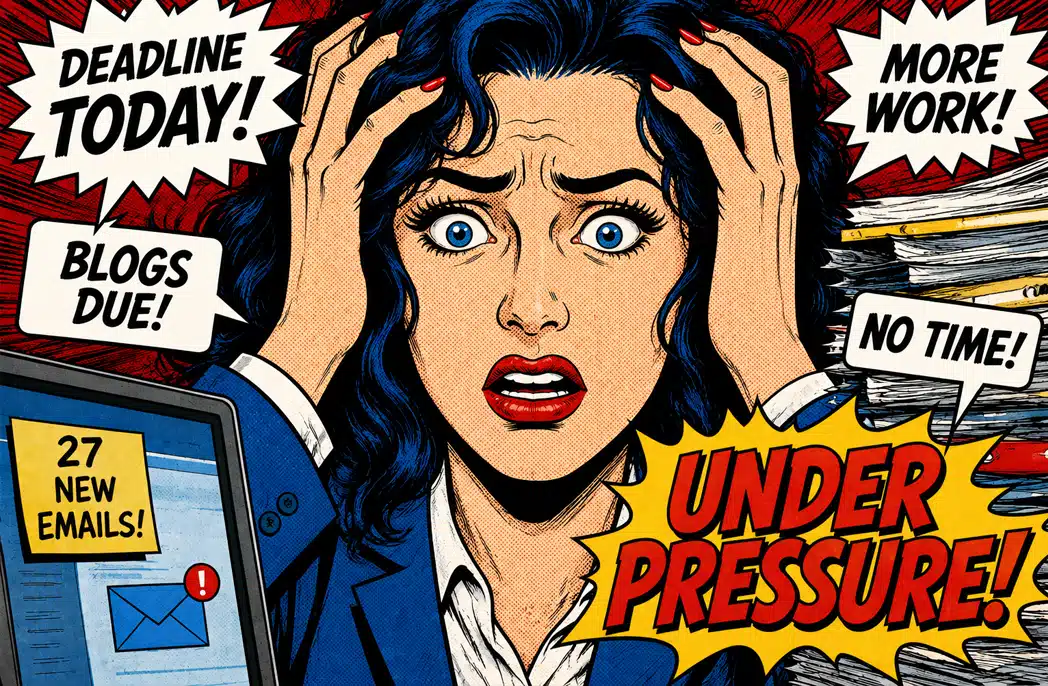
The internet is becoming a pressure cooker. Between 2022 and 2024, the number of AI-generated web pages increased 80-fold. That explosive growth appears to have moderated, with the proportion of online articles, blogs and listicles that are primarily AI-generated hovering around 50 percent for more than a year.
Even so, with half of online content now machine-generated, the internet is becoming a machine that consumes and reproduces itself. What began as a repository of human knowledge risks morphing into an engine that endlessly recycles, remixes and repackages existing ideas, expressing them through increasingly familiar structures, metaphors, transitions and turns of phrase – basically, a bastardisation of itself.
The AI-generated plateau may also be temporary. According to HubSpot’s ‘2026 State of Marketing Report’, around 94 percent of marketers plan to use AI in their content creation this year, and 83 percent say they are expected to produce more content than ever before as a result.
That expectation generates pressure from three directions simultaneously. There is:
- pressure to achieve the volume of content demanded by clients, managers and algorithms
- pressure to create effective content – 52 percent of marketers believe AI makes content so easy to create that it’s less effective overall, and
- pressure to create differentiated content – 53 percent of marketers struggle to differentiate their content in an AI-saturated market.
The contradiction is obvious. Organisations demand originality and differentiation while creating the very conditions that make those qualities more difficult to produce.
Pressure point #1 – more, more, more
Every time a manager or client directs a content creator to achieve volume outputs or meet unrealistic timelines, they increase the likelihood that the result will be low-quality ‘content pollution’: thin, generic, recycled, error-riddled, plagiarised or little more than ‘AI slop’.
Consider how familiar these instructions sound:
‘We need three blogs a week.’
‘We need to rank for these keywords.’
‘Give me something like [COMPETITOR].’
‘I need it by Friday.’
None of those instructions asks for high-quality content, originality or insight. Some actively discourage it.
Most discussions frame what follows as an ethical failure of content creators. Yet, through their demands, expectations and briefs, clients and managers are often complicit.
In this environment, AI doesn’t just enable shortcuts – it almost invites them.
When a brief says, ‘Give me something like [COMPETITOR]’, the instruction is to imitate – to ‘clone and cloak’ a competitor’s content.
When under pressure to achieve volume targets, or when a brief says, ‘We need to rank for these keywords’, the temptation is to prompt an LLM (large language model) to regurgitate existing material, further flooding the market with homogeneous content.
When a brief sets an unrealistic deadline, governance falls to the wayside. Fact-checking gets skipped. Reviews are compressed. AI outputs go unchallenged.
We blame the creator for content degradation while ignoring the systems that reward and demand derivative content.
Pressure point #2 – effectiveness
B2B marketers should be periodically reminded of content marketing’s core purpose: to create content that a carefully defined audience finds timely, relevant and valuable – and, in doing so, to move that audience through the buyer’s journey: from awareness to consideration, trial, repeat purchase and ultimately advocacy.
If a piece of content is not doing at least one of those things, it’s ineffective – regardless of whether it was created by a human or generated by AI.
This is where the volume pressure and the effectiveness pressure collide. Managers and clients demanding more content, faster, while simultaneously expecting it to perform, are making contradictory demands. Effectiveness is rarely a function of volume alone; it depends on relevance, quality, differentiation and insight. You cannot generate AI slop at scale and expect it to convert. Undifferentiated content – however efficiently produced – is invisible content.
The question marketers should be putting back to their managers and clients is a simple one: do you want more content, or do you want content that works?
Pressure point #3 – distinctly different
Content marketers operate within a contradictory system that rewards speed and volume yet expects differentiation.
Every brief directs: be distinctive, stand out, demonstrate thought leadership and create a unique brand voice. Yet, the operating environment demands publish more, publish faster, follow what works, copy the competition.
Genuinely distinctive content takes time and requires organisational investment. It requires subject matter experts to contribute, not merely approve. Distinctive content is usually built on assets that competitors cannot easily replicate; for example, original research and proprietary data, the views of a genuine thought leader, lessons learned from real projects, behind-the-scenes insights and client case studies told with specificity rather than sanitised testimonials.
Importantly, distinctive content is also authentic – a competitor can copy words, but they cannot easily copy experience.
It becomes easy to understand how the current system is hostile to producing original content.
AI is exceptionally good at generating plausible content. It is much less effective at producing differentiated content. This is because LLMs are trained on patterns. Their outputs tend towards what is common, expected and statistically likely. They excel at producing content that sounds right.
The more marketers rely on AI to generate ideas rather than express ideas, the greater the risk that their content converges towards the same language, structures and perspectives as everyone else. This is not necessarily plagiarism – it’s something arguably more insidious: homogenisation.
Final word
The opposite of AI-generated content is not human-generated content; it is experience-generated content.
Humans can produce generic, derivative content, too. What AI cannot readily reproduce is first-hand experience, proprietary insight, hard-won lessons, unique observations and authentic stories. Those are the raw materials of content that are truly distinct.
High-quality, effective, differentiated content will not be achieved if executives continue to demand more content with fewer resources, if clients insist on benchmarking against competitors, or for as long as marketing leaders measure volume rather than impact.
The three pressure points reveal a collective issue – one that sits across the entire chain and cannot be solved by any individual content creator.
Jacqueline Burns is the founder of Market Expertise
Image: Supplied
Read more: The fundamentally human jobs that AI still can’t commoditise


